

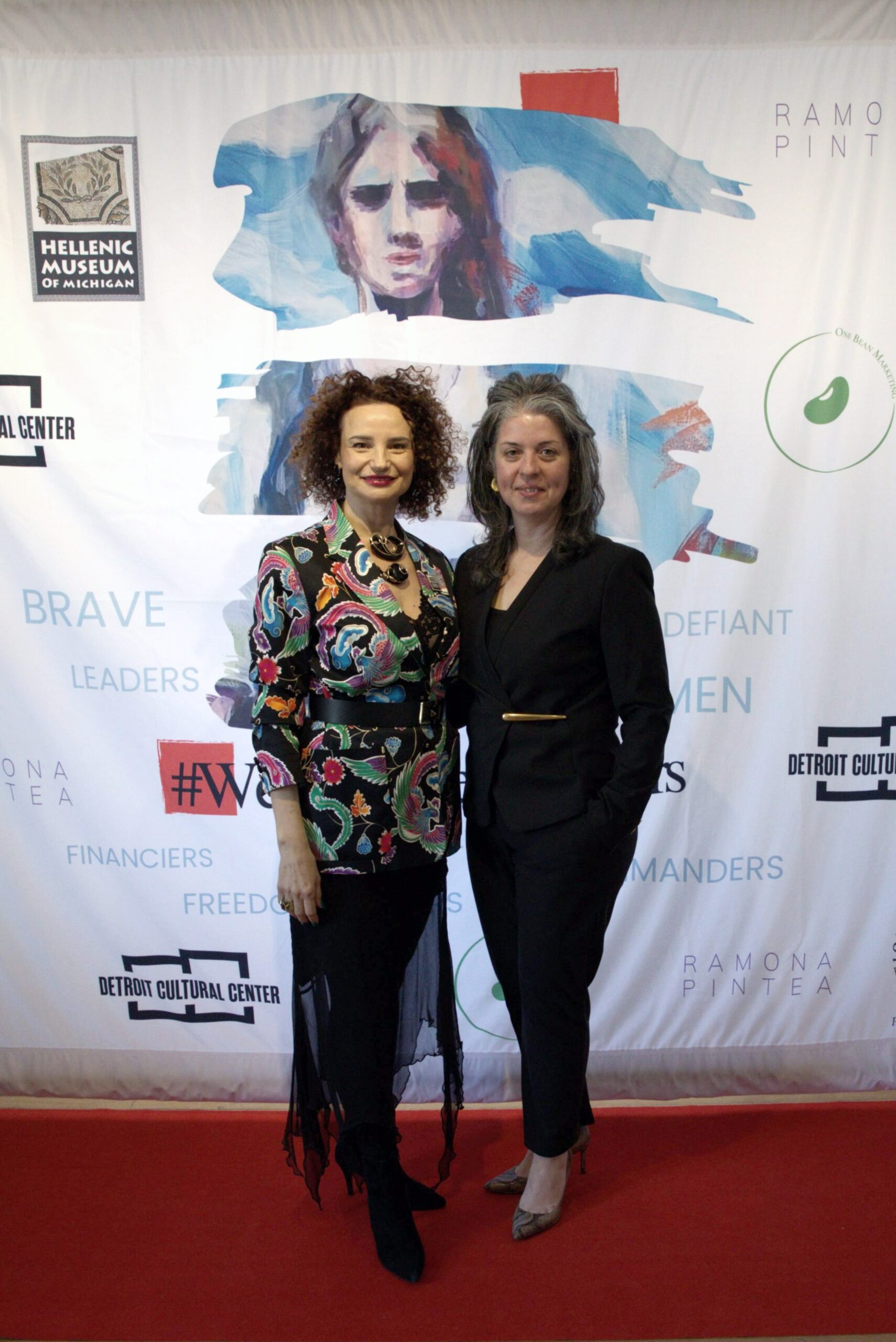
Angie Xidias chatted with #Powerjournalist Markos Papadatos about the #WeAreGreekWarriors social media campaign.
#WeAreGreekWarriors runs at Hellenic Museum of Michigan through May 17. The exhibit will travel to other cities.
You are the creator of the original #WeAreGreekWarriors social media campaign… How did that come about?
As a first generation Greek American, I grew up in a home where Greek history, culture, and education were at the center. I studied Classical Civilization and Hellenic Studies at NYU, which created a stronger foundation in my education and thought. Fast forward to my professional career and after co-creating the #WearYourCrown campaign in Washington, DC at Hotel Zena, the only women’s empowerment hotel in the world, I was already focused on elevating women’s voices. So when Greek Independence Day came, I asked myself: where are the women in this story?
We always hear about heroes like Kolokotronis, but when I started digging beyond Bouboulina, I found so many women who were leading in their own ways: funding ships, supporting the resistance, holding everything together.
That’s what led me to create #WeAreGreekWarriors in 2023. I wanted to bring those women and their stories forward to take their rightful place in history alongside Bouboulina, and the response was tremendous. But it showed me how many people, Greeks included, had never heard of them before.
What does it mean to you to go from creating an online social media campaign to co-curating a comprehensive exhibit which includes contemporary art, music concert, film, literature, and community engagement?
I feel empowered and, at the same time, amazed that something I created on social media resonated enough for someone to say that these women’s stories deserve a place in a museum–and in the larger conversation. For me, there’s no higher honor than that. I also felt an incredible responsibility to get this right, which is why it was so important to work with the Executive Director Harry Gaggos and Creative Director Evans Tasiopoulos at the Hellenic Museum of Michigan to co-curate an exhibit that tells their stories through a full artistic experience.
To now see it evolve into a full exhibit with art, music, film, and literature feels like we are finally giving these women the space they have always deserved and connecting to the community in a way that has not been done before. Women’s empowerment is universal, and these stories go far beyond the Greek community. Their stories resonate with anyone who understands strength, resilience, and leadership.
At the end of the day, it’s about impact, taking something from a screen and turning it into something people can physically see, feel, and connect with in real life.
The exhibit highlights stories of strength and resilience. What continues to inspire you as you bring these narratives to life?
What inspires and continues to empower me is the contrast and the power these stories have today. During that time in history, there were Greek women being sold into slavery by the Ottomans, as we see in The Greek Slave by the American sculptor Hiram Powers, but at the same time, there were women in positions who were courageous enough to find their power to fight not just for themselves, but for the freedom of Greece.
There is still so much to discover. I continue to find more women to highlight alongside Bouboulina, Tzavela, Mavrogenous, Visvizi, Karatza, the Souliotisses, the women of Messolonghi, and others whose stories deserve to be told.
Women’s empowerment is universal, and these women and their stories connect with anyone who understands strength, resilience, and leadership. The #WeAreGreekWarriors exhibit is having an incredible impact, reaching far beyond the Greek community. That inspires me and fuels me to continue this initiative.
Looking ahead, how do you envision the future of the #WeAreGreekWarriors exhibit within the Hellenic Museum of Michigan and beyond?
Seeing the response at the Hellenic Museum of Michigan, including visitors from Florida, Texas, Chicago, New Jersey, New York, and even South Africa has been incredibly motivating. It’s clear these women’s stories resonate far beyond one community or one space.
My vision is to bring this exhibit into more mainstream institutions, places like the Brooklyn Museum in New York, collaborating with the National Women’s History Museum in Virginia, and the National Museum of Women in the Arts in Washington, D.C., along with other major museums and galleries across the country, so these stories can reach an even wider audience.
Women’s empowerment is universal, and the Greek Revolution itself helped inspire movements like women’s suffrage and the abolition of slavery here in the U.S. More reasons why these stories are so important to spread far and wide. It’s not just a Greek story, but an international one.
At the same time, we’re already receiving interest from people asking us to bring the exhibit to other prestigious Hellenic institutions like the National Hellenic Museum in Chicago and the Hellenic Museum of Melbourne, which shows how global this can be. This exhibit should absolutely travel to Greece as well.
Wherever this exhibit resonates and people want it, that’s where we’ll go.
How has your Greek-American heritage shaped your perspective in curating an exhibit centered on these women’s stories of resilience and cultural pride and how did Ramona Pintea come to represent the women of the Greek Revolution through her contemporary art?
Sharing the stories of the women of the Greek Revolution comes from a duty to support those who have been overlooked or left out of the narrative. It’s about saying, “These women shaped history too.” Their names should be known. They were changemakers, and they deserve the same recognition and accolades we so often give only to men. We celebrate figures like Kapodistrias and the powerful roles men played, but women were just as critical to the Revolution. This exhibit is about striking that balance.
I wanted the exhibition to be more than just the campaign prints, and I have worked with Ramona Pintea before. Ramona is an internationally renowned artist, and her work is incredibly powerful. I knew she was the right person to bring these women to life. She paints women from a woman’s perspective, tapping into an emotional depth that feels real and human.
Her style, especially seen in her Urban Queens collection, portrays women as bold, fearless, and strong, and she brought that same energy to the heroines of 1821. What she has done with the women of the Greek revolution is humanize them as mothers and daughters. You see them as historical figures but also as real women, with emotion, strength, and courage.
There is also a very special connection. Ramona is Romanian, and one of the heroines, Rallou Karatza, was a Greek princess who lived in Bucharest, the same city Ramona is from. There’s something powerful about that connection, and about women telling the stories of other women. This collaboration was very intentional because having a woman portray Greek women further aligns with the universal theme of women’s empowerment. You do not have to be Greek to understand the heroines of 1821. Ramona’s work is stunning and evocative.
For those who have experienced or are interested in this exhibit, what advice would you give to individuals who are inspired by the stories of Greek heroines?
Say their names. Learn their stories. And find your own strength in them. These women didn’t wait for permission. They stepped into who they were. Recognize that greatness isn’t always in big moments; it’s in the everyday choices, the resilience, and the courage you show in your own life. These women remind us that we all have that power within us.
What message do you hope #WeAreGreekWarriors sends about the Greek American community in the United States today?
I hope it shows that our stories deserve to be seen beyond our own community. We have done a great job preserving and celebrating our culture within the Greek American space, but now it’s time to expand that reach. Our history has shaped so much, and it belongs in mainstream conversations and institutions like the Brooklyn Museum and other important spaces.
These stories resonate far beyond the Greek community. We just have to tell them in a way that connects, through a universal language of strength, courage, and emotion, and I think the #WeAreGreekWarriors Exhibit at the Hellenic Museum of Michigan shows us that it is possible.
The exhibit centers on perseverance and identity. How do you personally define “success” within that context?
For me, success is about impact. It’s about using your voice and creating space for others to feel seen and empowered. Within the #WeAreGreekWarriors exhibit success means these women are no longer overlooked, that their names are spoken, their stories are being told, felt, and carried to the next generation.
No matter if you are a man or a woman, if you walk away feeling stronger, seeing your own greatness, and being inspired, that’s success to me. I am so excited about this exhibit, who it is reaching, and where it is going next.