
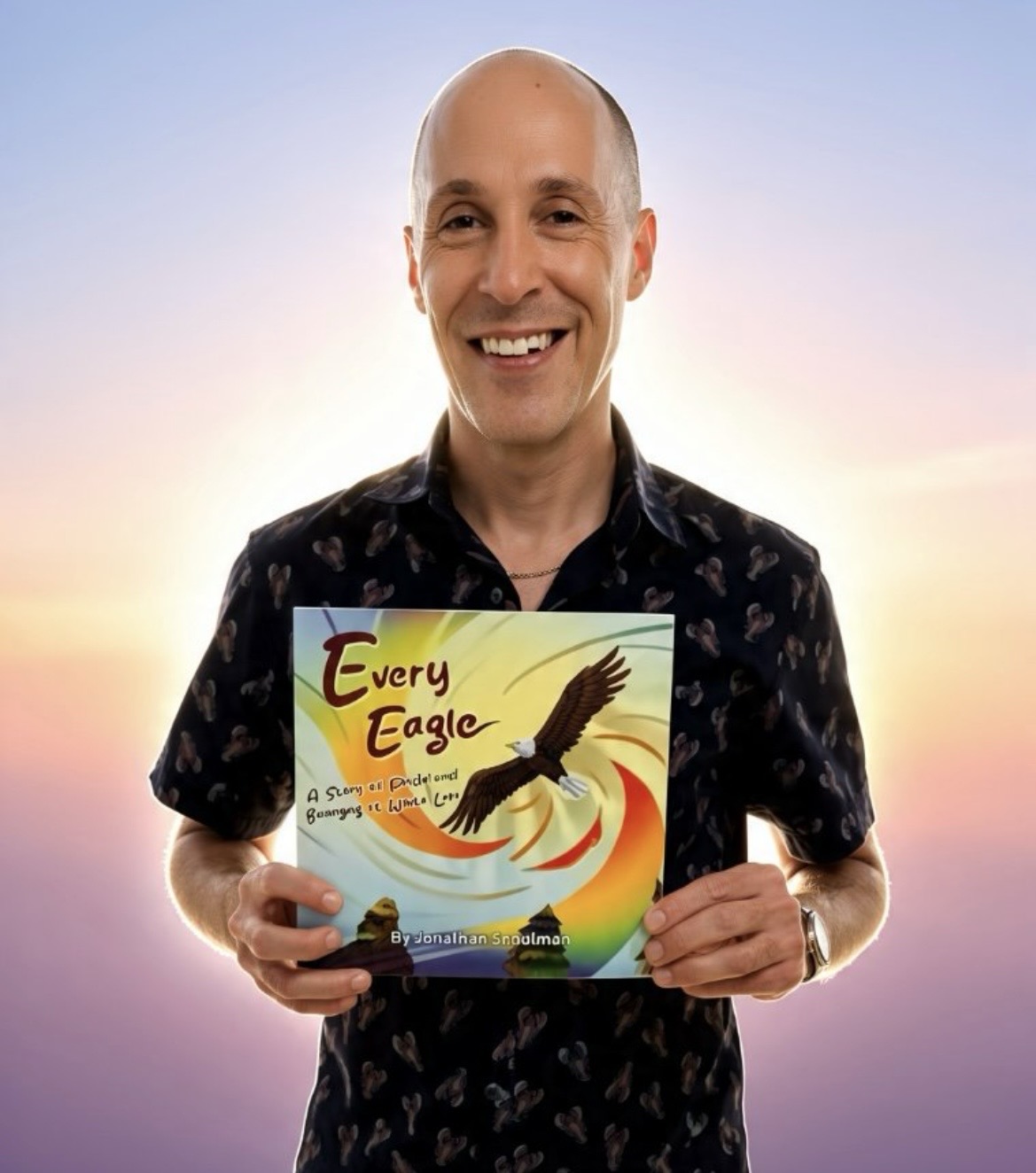
Big Apple Teacher Award winner Jonathan Schulman chatted with #Powerjournalist Markos Papadatos about his new book “Every Eagle: A Story of Pride and Belonging at White Lake.”
What inspired you to write this new children’s book?
As an elementary educator, I’ve always believed in the power of stories—how they can show young readers something special about themselves, and how they can project new worlds that they’ve never explored. Every Eagle: A Story of Pride and Belonging at White Lake was born out of those two ideas—that individual differences should be celebrated and that communities become closer the more you learn about each other.
Were you going for a certain theme?
Absolutely. Growing up during the summers at White Lake in the beautiful Catskill Mountains, I knew I wanted nature to be a unifying theme. Every Eagle highlights that beauty by centering around a bald eagle and her family which we’ve encountered over the lake in recent years. In the story, as Mother Eagle delicately cares for her young, she sets an example of how the proud, but competing families of White Lake can get along by looking at life from a new perspective.
How did you approach your writing process?
Writing always starts with a seed idea and usually when you least expect it. In my case, it happened naturally when I saw the eagle soaring gracefully over White Lake above our small, summer bungalow houses. So, I sat down on my wooden porch in front of the wild, growing patch of black-eyed Susans and began to write.
From there, I devised a conflict of multigenerational family dissent involving time-honored traditions amongst an ever-progessive world. It was fun creating details that were exaggerated and slightly wacky precisely because the REAL families of White Lake get along just fine!
What did this book teach you about yourself?
I learned that communities are made up of unique individuals who have pride in themselves and what they do. They also have a desire for belonging. It made me think about where I belong and how I can still be myself within the larger group.
What do your plans for the future include?
Well, since Every Eagle is part of the newly created White Lake Series, I plan on writing 3 more books featuring a native animal displaying values children can learn from — all in the natural setting of White Lake and its varied environment. Every Turtle is already trudging along, while Every Bear is up in the trees, not far behind. I’ll leave the last one a mystery for my readers.
How does it feel to be an author in the digital age?
It’s an interesting feeling, to be sure. As a Gen-Xer who grew up before personal computers, but then saw the rise of the Internet, smartphones, and more recently AI, I think what I’m doing brings me back to my younger days and connects me even more to my community.
Call it place-based learning for adults! I’ve really needed to investigate the places in White Lake I’m writing about — study them on a deeper level. This brings me all over — to the lake, the shoreline, the woods, the flower beds, the brook, the mountains, and the heart of the small towns. I find myself walking around more, writing on my notepad more, and taking in the sights, sounds, and smells rather than clicking and scrolling.
What is your advice for young and emerging writers/authors?
I would tell them to do the same thing I’m doing, and it’s the same thing I tell my students: Go out in the world and explore. Don’t just look. Observe! See what makes you happy, angry, puzzled, amused, and curious. Then jot down what it is and why it makes you feel that way. I guarantee it’ll stick in your brain and you’ll want to take action on it.
That action doesn’t have to mean going to Town Hall and requesting a meeting (foreshadowing in my next book). It can come in many different forms, from writing, researching, reading, discussing, and debating. That leads to critical-thinking, which is a skill that, with practice, can help emerging writers and authors engage with their stories more deeply.
What does the word success mean to you?
Success means following your passion. To me, that’s bigger than following other things like fortune and fame because it instantly inspires others. People see the joy you put into your work and that helps them find their own inspiration. I feel lucky to be able to follow my passions, which are teaching and writing, because they not only provide structure in my life, but a purpose to which I can set goals for, learn new things, and spark new interests.
What’s the one thing you want people to get out of this book?
Meaningful conversations. I want people to share what they learn from it, talk about what resonates with them and what makes them connect to it.
On the other hand, I want people to talk about what they find challenging from the story. The only way to do that is to engage with each other and ask questions. What makes them smile? What parts connect to their lives, their families, their communities? What makes them uncomfortable, and why? I think any book that does that is worth keeping on your shelf. I hope Every Eagle is one of them.
“Every Eagle: A Story of Pride and Belonging at White Lake” by Jonathan Schulman is available on Amazon.