

There is a version of showing up that the music industry has perfected over the last decade or so. You know it when you see it: the carefully crafted stage entrance, the tour-rehearsed banter between songs, the setlist designed to peak exactly when the cameras are most likely rolling. It is performance in the most clinical sense of the word. It hits the marks. It fills the room. And it leaves almost no trace once the lights come up.
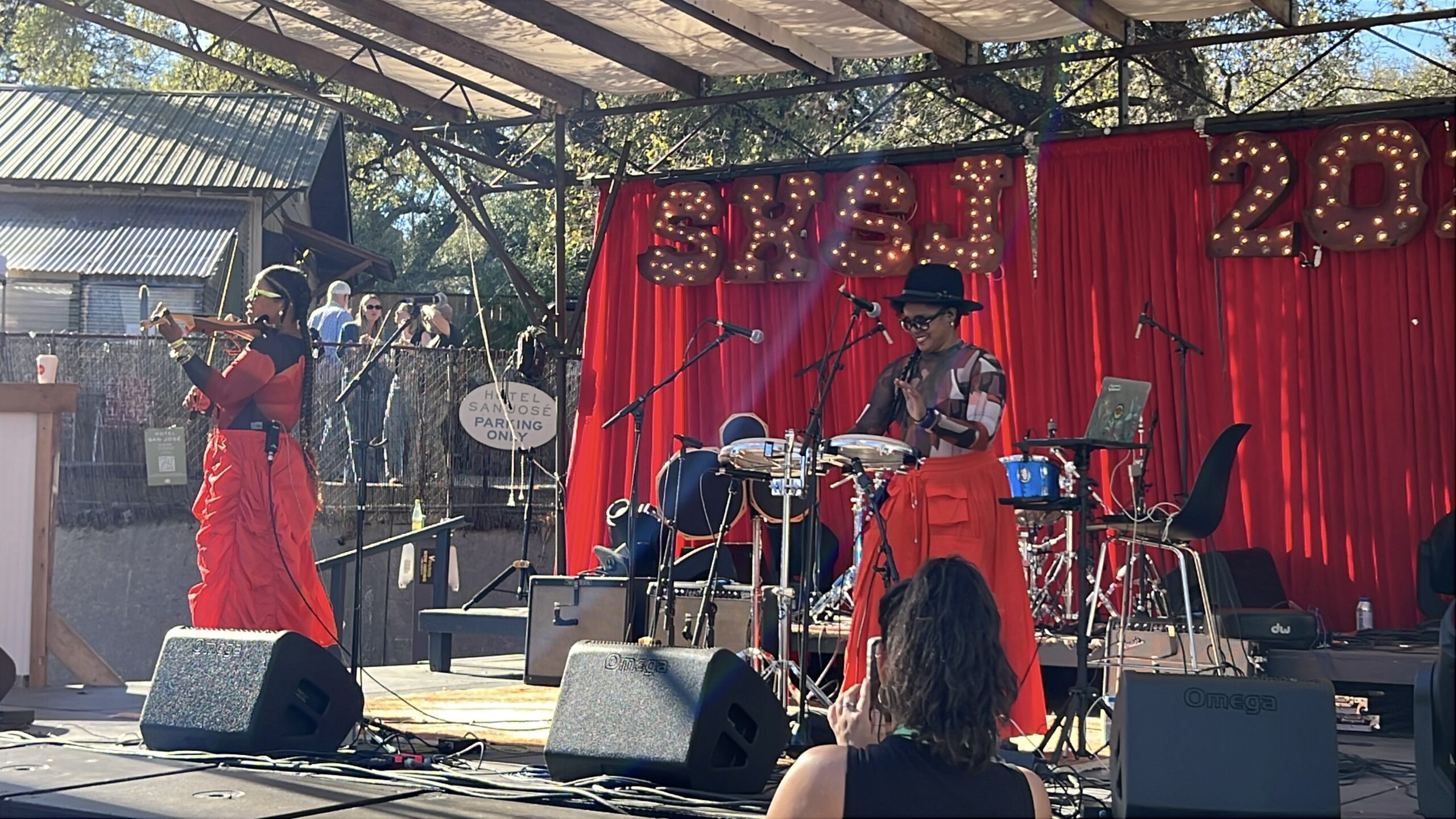
Then there is what OKAN did at this year’s South by San José (SXSJ) during SXSW 2026 in Austin, Texas on the grounds of Hotel San José.
I have been to a lot of shows. I have stood in a lot of crowds. I have watched a lot of artists do their level best to connect with a room full of strangers in the middle of the afternoon sun. But I cannot remember the last time I watched an entire audience collectively surrender — phones pocketed, feet rooted, something behind the eyes going very quiet and very awake at the same time. That is what happened in the parking lot of Hotel San José on a March afternoon in Austin, Texas, and I am not sure I have the right words for it yet. But I am going to try.
The context that makes SXSJ matter
First, I want to begin with a word about where we were standing.
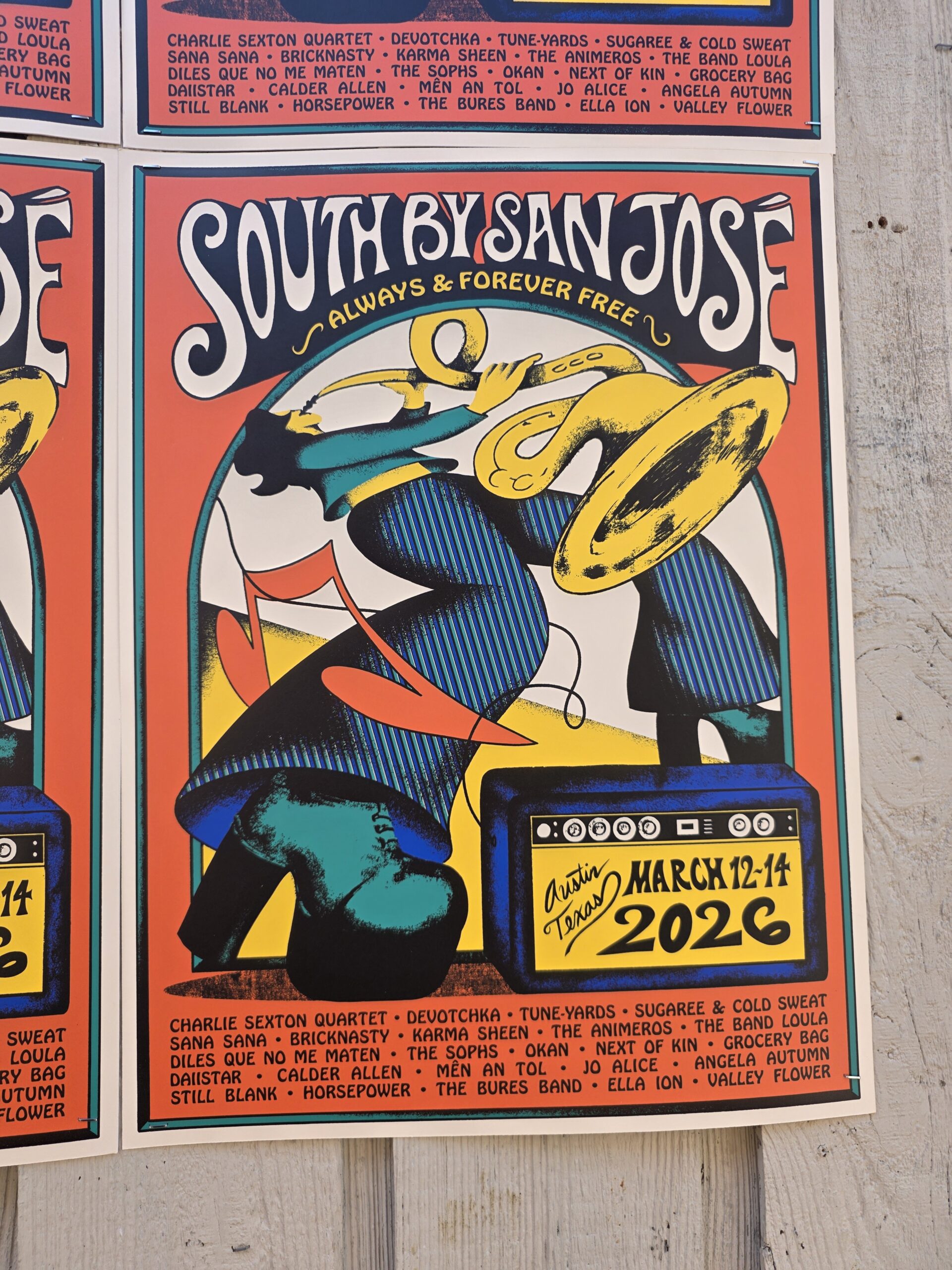
South by San José (SXSJ) is not an unofficial SXSW party in any meaningful sense of that phrase. It is something older and more intentional than that. Since 2000, Hotel San José has opened its parking lot every March to live music, local vendors, makers, and anyone who wants to walk in. No badge. No special wristband. No prior registration. Gates open at noon. The music starts. The rule has never changed in 27 years: always and forever free.
That commitment reads differently in 2026 than it did in 2000. The city that SXSJ was born into: scrappy South Congress, the Continental Club across the street, a hotel that had just been rescued from decades of disrepair by a West Texas lawyer with a camera and a vision — barely resembles the Austin that exists today. SXSW itself is in the middle of a complicated reckoning, attendance numbers still climbing back from COVID-19 pandemic lows, the Austin Convention Center demolished, the Innovation Awards quietly canceled. The festival that once felt like a genuine discovery engine has spent years trying to recalibrate its relationship with the city it occupies and the culture it claims to serve.
But SXSJ has none of those problems. It has stayed the size of a parking lot. It has stayed free. And every March, it draws the kind of crowd that reminds you what music was supposed to be about before it became a content vertical. Hotel San José understands this, and how could it not?
This year’s 24-act lineup included Charlie Sexton Quartet, DeVotchKa, Tune-Yards, and a roster of emerging and international acts that reflected SXSJ’s long-standing commitment to curation over hype. But the set that stopped time — the one that turned the afternoon into something I will be processing for a while — belonged to OKAN.
Meet ‘OKAN’ – a declaration from the heart
Elizabeth Rodriguez and Magdelys Savigne have been building toward this kind of moment for almost a decade, and the weight of that journey was present in every second of their performance.
Both women were born in Cuba — Rodriguez in Havana, Savigne in Santiago de Cuba — and both were classically trained at the same conservatory, though they did not meet until they separately made their way to Toronto to join Jane Bunnett’s all-female Afro-Cuban ensemble Maqueque. Rodriguez had come first, in 2013, to perform at a classical festival in Hamilton. Savigne followed in 2014. They fell in love. In 2017, they left Maqueque and built something of their own.
The name they chose was OKAN — the word for ‘heart‘ in the Afro-Cuban religion of Santería. It is not a casual choice of branding. It is a declaration of what the music is made from and what it is meant to reach.
Their catalog reflects the full complexity of who they are: Elizabeth on violin and vocals, Magdelys on batá drums and percussion and vocals, both singing in Spanish, Yoruba, and Spanglish, weaving Afro-Cuban roots with jazz, folk, classical training, and the particular kind of restlessness that comes from building a life far from the place that made you. Their 2020 album Espiral won the Juno Award for World Music Album of the Year. Their 2023 release Okantomi — the title meaning ‘ocean’s heart‘, and also Magdelys’s religious name — won the same award in 2024, appeared on NPR’s Alt Latino best-of list, and drew praise from Billboard, Songlines UK, and Le Monde. They are Grammy and Latin Grammy nominees. They have collaborated with Bomba Estereo, Lido Pimienta, and the Halifax Symphony Orchestra.
None of that fully prepares you for what they do live. A great introduction to the sound of OKAN can be experienced from their 2024 Tiny Desk Concert, as presented by NPR Music.
What happened in that parking lot
The afternoon had been moving the way SXSJ afternoons tend to move — loose and warm, the crowd cycling in and out, a mix of Austinites who had long since stopped going downtown during SXSW week and visitors who had found their way to South Congress on a tip or a gut feeling. The vendors were set up. Jo’s Coffee was doing its thing. The sky was doing what a March Austin sky does when it wants to be generous.
And then OKAN started playing.
The first thing you notice is the percussion. Magdelys Savigne does not play drums the way most people play drums — which is to say, she does not use them to keep time so much as she uses them to speak. The batá drums carry specific spiritual weight in Santería tradition, used to communicate with the orishas (deities), and whether or not you know that context when you hear them, something in your body does. There is a physical intelligence to the sound that bypasses the analytical mind entirely. Your feet move before you decide to move them. Your chest opens before you realize it was closed.
Elizabeth Rodriguez’s violin arrived next — not the European classical instrument you might expect from someone who was once concertmaster of the Havana Youth Orchestra, but something transformed. She plays with the full authority of that training and then bends it, stretches it, sends it somewhere that Beethoven and Mahler never imagined it could go. She has talked about how Cuban conservatory education stripped students of their cultural identity, forcing them to perform Western classical forms while their own musical heritage was kept at arm’s length. What she does on stage now is a kind of reclamation — the classical violin in conversation with Yoruba chant, jazz improvisation, and the particular ache of a love song written in exile.
What they built together, in that parking lot, in the middle of a Tuesday afternoon in March, was something I can only describe as a trance. Not in a metaphorical sense. People stopped moving. People stopped talking. The ambient noise of a South Congress afternoon — the traffic, the ambient SXSW buzz bleeding in from downtown, the ordinary hum of a city going about its business — fell away. The crowd stood still the way people stand still when they have stopped trying to experience something and have simply started experiencing it.
The crowd was in its own trance. Off their phones. Caught in the addictive pull of sound that moved through the body before the mind had a chance to weigh in.
I watched people reach for their phones instinctively — the reflex is so deeply ingrained at live shows now that it’s almost biological — and then put them back. Not because they were told to. Not because anyone around them was judging. But because what was happening on that stage was more interesting than any documentation of it could possibly be, and some part of them understood that immediately.
That is not a small thing. Getting a crowd of SXSW-week attendees, people who have been conditioned to experience live music as content to be captured and shared, to simply be present — to surrender the mediation of the phone screen and just stand there, open, letting the sound do what sound can do — is perhaps the most radical act a performer can pull off in 2026. OKAN did it without asking.
The conversation that wasn’t separate from the music
What made OKAN’s set at SXSJ different from a technically brilliant performance was the way they spoke to the crowd between songs — and the way those conversations were not separate from the music but continuous with it.
Acceptance. Universal power. The release of anger and grief through sound. These are not light topics for a Tuesday afternoon in a hotel parking lot. They are also not topics that most artists are willing to raise with a standing crowd of strangers, especially during a festival week when the social contract tends toward the celebratory and the commercially safe.
OKAN raised them anyway. And the crowd did not flinch. They leaned in.
Part of what made it work is that the ideas were already in the music before they were spoken aloud. OKAN’s catalog is built on themes of immigration, resistance, and love — the particular kind of love that survives displacement, that carries the weight of a homeland you can’t fully return to and a new country that doesn’t fully hold you. Magdelys has spoken publicly about what it meant to come out as a percussionist in a Cuban culture that historically excluded women from the batá drums — an act of defiance she has described as inseparable from coming out as a lesbian in a country where that carried its own enormous risk. These are not background details. They are the material the music is made from.
When that material hits a crowd in Austin, Texas, in March 2026 — a city processing its own questions about who belongs, who gets priced out, what keeps changing and what is worth protecting — it does not land as a foreign transmission. It resonates. It hits differently than it would in a vacuum, because the questions OKAN is asking are not only theirs.
The universality of that moment is exactly what I have been trying to articulate in my coverage of this year’s SXSW: what it means to actually show up. Not to perform showing up. Not to brand around the concept of community while keeping the real thing at a careful distance. But to walk into a room — or a parking lot — and give people something they can actually feel, and trust that the feeling is enough.
OKAN showed up.
What SXSJ was always for
There is a version of SXSW week that is about transactions: deals made, contacts exchanged, brands activated, platforms launched. That version is real and it has its place and it will continue to define the official festival’s identity in ways that are sometimes uncomfortable and sometimes genuinely useful.
And then there is SXSJ. Which has always been about something else.
Hotel San José built this event on a single, durable idea: that music is a community act, that the parking lot belongs to everyone, and that the right artists in the right space can do something that no amount of badge access or brand sponsorship can manufacture. For 27 years, that idea has held. The city around it has changed beyond recognition. The festival it shadows has expanded and contracted and changed ownership and lost its founding president and canceled its award ceremony. The parking lot has stayed the same.
What OKAN brought to that parking lot this year was everything SXSJ was designed to hold. Music from the inside of a life — a complicated, exile-shaped, love-built, rhythm-deep life — delivered without a safety net to a crowd that had no idea what was coming. A violin that knew things. Drums that spoke. Two women from Cuba who built a life in Canada and named their project after the Yoruba word for heart, standing in Austin, Texas, making a room full of strangers feel, for a sustained and startling stretch of afternoon, that the heart was the right place to be operating from.
I don’t know if I can say it any more plainly than that.
That is what showing up looks like. Not the press release version. Not the brand activation version. The real one.
The one where you bring your full self: your roots, your grief, your joy, your religion, your defiance, your love — and you play your heart out in a parking lot on South Congress in March, and the crowd puts their phones away, and the city goes quiet for a while, and something passes between the people on the stage and the people standing in the sun that neither side will be entirely able to explain afterward.
OKAN gave that to everyone who was there. And Hotel San José, for the 27th year running, gave OKAN the space to do it.
That is, in the end, what all of this is supposed to be about.
You can learn more about OKAN by visiting their website.