

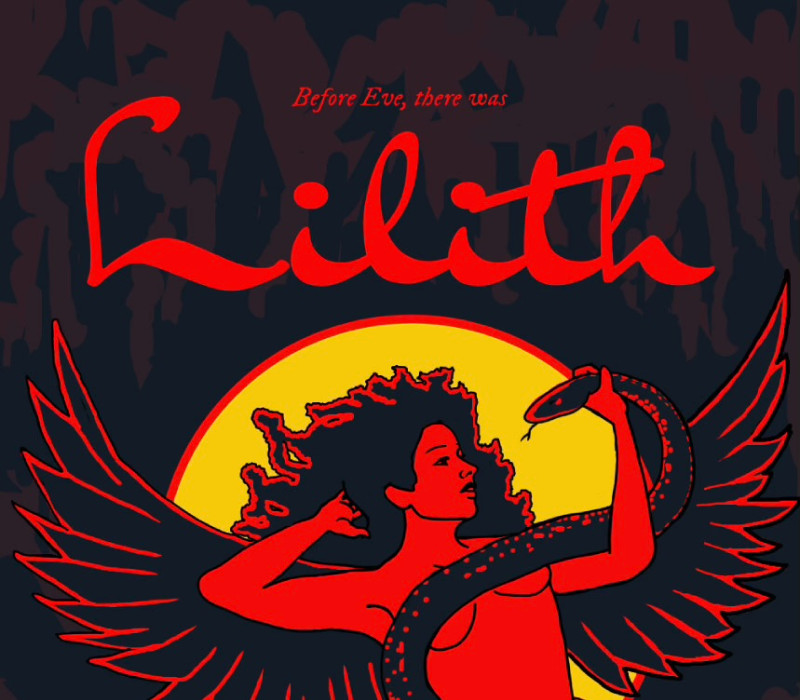
Executive producer Bhavani Rao chatted with #Powerjournalist Markos Papadatos about the play “Lilith,” which is being performed at The Tank from August 7 to 22, 2026.
How did “Lilith” come about?
After teaching a class on the business of screenwriting at Antioch University, one of the students reached out and asked if we could have an informational coffee. That student was playwright Adina Aaron.
Over coffee, Adina told me about a play she had written called “Lilith.” The way she narrated the story immediately intrigued me. I knew pieces of the Lilith mythology, but Adina had immersed herself in the many different versions of it and found her own way into the story. After reading the play, I knew I wanted to be part of bringing it to life.
Adina had already been working on Lilith for several years. She immersed herself in research surrounding the mythology, studying ancient texts, feminist reinterpretations, and contemporary social discourse. She took pieces from the many versions of the Lilith mythologies and created an interpretation that bridges mythology with modern experience.
And to be clear, Adina has never claimed that this is the historical truth or the complete mythology of Lilith. There are so many different versions of her story. What Adina has done is take those different traditions and interpretations and create something uniquely her own, while reclaiming a woman who has been silenced and demonized for centuries.
The play had already gone through a real development process. It was featured in The Bechdel Group’s 2023 Fall Workshop Season, had multiple staged readings in Los Angeles and New York, and was a semifinalist for the Eugene O’Neill Theater Center.
What excited me as a producer was the opportunity to help bring a powerful play like Lilith to life. Adina had spent years building and developing this world, and I wanted to help her take that work from the page and the reading stage into a fully realized production in front of an audience.
What did your job description as executive producer involve?
Everything and anything! As silly as that may sound, it’s both having the 10,000-foot view and making sure we’ve triple-checked the program.
A big part of my role is fundraising, not only for this production, but also thinking about the future of Lilith and what it could look like in other cities. There’s a lot of strategic networking, community building, and outreach. You’re always planning for what comes next while you’re building what’s in front of you now.
For the current production, once you have a great team in place, I think the executive producer’s job is to be both there and not there. Be there when you’re needed, solve the problems that need solving, make sure everyone has what they need to do their best work, and then give them the room to do it.
With Lilith, that meant supporting our brilliant playwright, Adina, our amazing director, Samantha Ozeas, and our wonderful team while giving them the space to bring this powerful story to life.
What was it like working with the cast and crew?
A dream. When the right people come together, magic is the only thing that can come out of it.
This is my first time working with everyone on Lilith, but what brings it all together is that many of them have known and worked with each other before. There was already a wonderful shorthand and trust among the team.
Our amazing producer, Scotty Lockwood, is someone I know I’ll be working with forever. Producing is basically juggling flaming swords while riding a unicycle and being asked to recite Shakespeare, and Scotty has been right there alongside me, doing it all with such effortless ease.
Every member of our cast and crew has brought so much care to this production. From Jenna Norton, our brilliant stage manager, to Ningning Renee Yang, our scenic designer, there has been incredible attention to every detail on that stage. On the other side of the production, it has been such a delight working with Ash Anderson on our marketing and PR and Alyssa Melani on our impact fundraising.
There is a generosity to this company. Everyone wants the play to be the best it can be, and there’s a tremendous amount of joy in creating alongside people who genuinely love bringing stories to life.
Working with our director, Samantha Ozeas, has been incredibly fulfilling. Sam brings this wonderful combination of a director’s eye, a deep respect for the playwright’s words, and a real generosity toward the actors and everyone around her.
They came to Lilith with an incredible foundation, having developed work with companies like Ma-Yi Theater Company and SoHo Playhouse, assisted at Playwrights Horizons and Audible Theater, and worked with and learned from some extraordinary theater artists. But what I have loved most is watching Sam take all of that experience and make it completely their own. They understood the heart of Adina’s play and created the space for the actors and the entire creative team to find it together.
What did this play teach you about yourself?
“Lilith,” to me, is about freedom of choice.
In my life and throughout my career, I’ve been blessed to be surrounded by strong women who always encouraged me to be bolder, braver, brighter, and to choose my own path. It’s what led me to create South Asian Women in Entertainment.
My heart breaks when I look at where we are at this moment in time with women’s rights, LGBTQIA+ rights, and, simply put, human rights.
“Lilith” is so much more than a woman who refused to submit to Adam. Lilith chooses herself. She chooses her freedom. She chooses to experience life beyond what someone else has decided her life should be.
Working on this play reminded me how important that choice is and how much courage it can take to make it.
Our mission statement asks the question I keep coming back to: What is freedom, and what do you have to sacrifice for that freedom? The mission of Lilith is to awaken the spirit of Lilith in everyone who sees the play—the courage to question, the strength to choose, and the freedom to define your own path.
That’s what I want for myself. And that’s what I want for the world.
What do your plans for the future include?
We are so grateful to The Tank for giving us a place to begin this journey, but this really is just the beginning for “Lilith.”
We plan to continue bringing the play to audiences across the country and sharing the spirit of “Lilith” with people who want more, who question the world around them, and who are looking for the courage to choose freedom and define their own path.
Over the next year or two, we would love to see “Lilith” in theaters throughout the country. Ultimately, the dream is to bring her back home to New York, onto a Broadway stage, and then, hopefully, out into the world.
I’m excited to see just how far “Lilith” can fly.
How does it feel to be a part of the digital age? Now with streaming, technology, and social media being so prevalent.
My handwriting was so horrible growing up that everyone thought I was going to be a doctor. So, at a very young age, my dad got me a computer. Within three lessons, the tutor he hired had me helping him train other people on spreadsheets and word processing. Simply put, I think I was part of the digital age before we were calling it the digital age.
My career has taken me through both traditional media, including Entertainment Tonight and Disney, and digital entertainment companies like Television.com and Sezmi. The technology has changed enormously, but for me, the most important thing hasn’t: understanding your audience, reaching them, and giving them a story to laugh with, to fall into, and, hopefully, to open their minds.
I love television. I love content. I love stories. Stories are the empress of all things. They change the way we see the world and, sometimes, the way we live our lives. Whether it comes through a traditional cable provider, a streaming platform, or whatever technology comes next, great storytelling is still great storytelling.
Media has an extraordinary ability to reach and influence people, and it is a privilege to have spent my career working in it. What excites me now is continuing to discover and develop creative talent across cultures, communities, and generations, and championing bold, original work—wherever audiences are watching.
What does the word success mean to you?
As a child, my dad used to call me dynamic. Not adorable. Never sweet or quiet. Dynamic. That word stuck with me, and to me, it has become synonymous with success.
Success, to most people, means reaching your goals. But goals, to me, are ever-changing. Once you hit one, do you stop? Did soccer legend Megan Rapinoe score one goal and stop playing? No.
My mentors—both those I’ve been fortunate enough to know personally and those I’ve learned from by watching their careers—have taught me about the kinetic nature of success. Shannon Gaulding and Sarah Schechter, both of whom were my PGA mentors, and giants like Shonda Rhimes, Jennifer Yales, Greg Berlanti, and the ever-mighty late Norman Lear have all shown me that success isn’t about one thing or one moment. It’s about how you execute your goals, what you do once you reach them, and how those goals continue to evolve.
That idea is at the very core of who I am. It comes from how I was raised by my immigrant parents, from my own experiences, and from what I’ve learned from these incredible gurus along the way. To me, success is dynamistic in nature. It cannot exist in inertia.
Simply put, success means to keep reaching, changing, creating, and evolving.
What would you like to tell our readers about “Lilith”? What’s the one thing you want them to get out of it?
“Lilith” is a beautiful play about a woman who chooses freedom. But it is also a call to action, a movement, and an invitation to awaken something within ourselves.
It may be inspired by an ancient myth, but the questions it asks are very much a part of the world we are living in today: What does freedom mean to you? What are you willing to sacrifice for it?
Come see “Lilith.” Come awaken that spirit within yourself—the courage to question, the strength to choose, and the freedom to define your own path. And hopefully leave the theater ready to make a little more room in the world for others to do the same.
To learn more about the play “Lilith,” click here.