

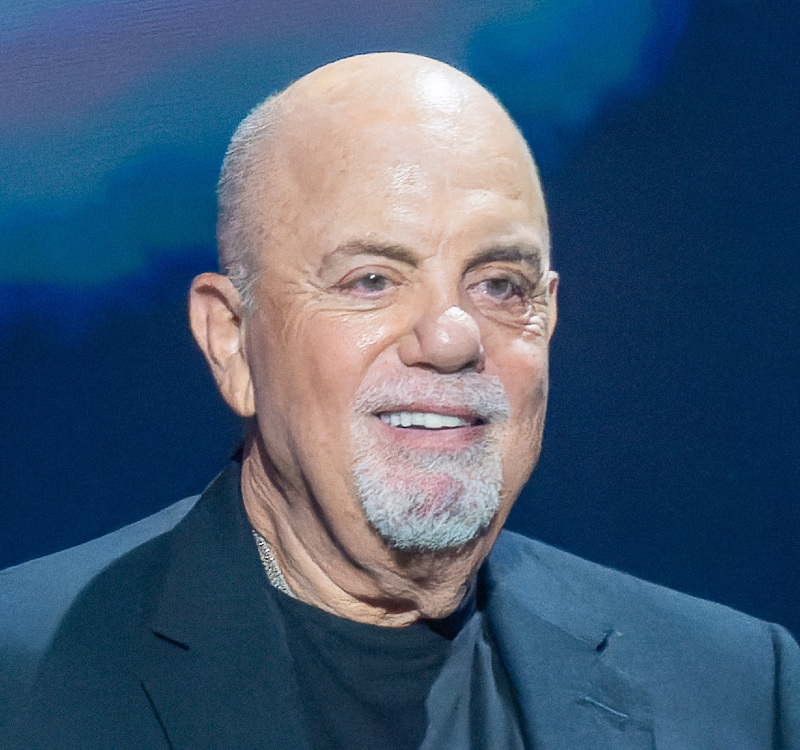
Billy Joel’s absence from the New York Times’ “30 Greatest Living Songwriters” list is inexcusable and impossible to defend. #Powerjournalist Markos Papadatos has the scoop.
Lists are designed to provoke arguments. They invite outrage, celebration, second-guessing, and endless debates over coffee and comment sections on social media. Every so often, a list makes an omission so glaring that it stops being a conversation starter and starts looking like a credibility problem.
That is exactly what happened when the New York Times published its “30 Greatest Living Songwriters” list without Billy Joel. The “Piano Man” was absent entirely.
This wasn’t simply a snub of a commercially successful artist. It was the omission of one of the most prolific American songwriters of the past half-century — a musician whose catalog managed to be literate without pretension, populist without pandering, and deeply New York without ever losing universal appeal.
Billy Joel is an American institution. He occupies a significant place in the cultural hierarchy. His songs became standards, because generations know every word to “Piano Man,” “Scenes from an Italian Restaurant,” “New York State of Mind,” or “Vienna,” some tastemakers mistake familiarity for simplicity.
Often, familiarity is the clearest evidence of mastery.
Writing songs that millions of people carry around for decades is not easy. Writing songs that endure across class, geography, and generation is even harder. Joel was able to do both all while moving fluidly between styles that most artists spend entire careers trying to master individually. He is Rock and Roll’s “Working Man’s Poet” and a chief architect.
He could write narrative ballads, hard rock, orchestral pop, adult contemporary, jazz-inflected character studies, doo-wop pastiches, and emotionally devastating piano laments — often within the same album in the same decade.
“Scenes From an Italian Restaurant” alone should qualify him for inclusion on any serious songwriting list. The song unfolds like a short story, shifting movements and emotional textures with the confidence of a composer who understood structure as deeply as melody. It is cinematic without becoming self-important. The characters feel lived-in, recognizable, heartbreakingly ordinary.
The same holds true for “Piano Man” and “New York State of Mind.” Ironically enough, in his signature tune “New York State of Mind,” he gives a shout-out to the publication (“New York Times”) that snubbed him from this list.
And that may be the real reason Joel gets overlooked by elite cultural institutions: he writes about ordinary people too well.
One is left questioning and wondering… how young were the people compiling this “30 Greatest Living Songwriters” list? His music spans at least three to four distinct generations of listeners, extending far beyond his initial 1970s and 80s audience to include a massive, modern Gen Z following.
Billy Joel’s songs are crowded with people who rarely appear in “serious” artistic conversations unless filtered through irony or grit.
Joel trusted melody, conversational yet not contrived lyrics, and storytelling. Billy Joel is the musical heart and soul of New York.
Billy Joel’s musical gift is precision. “Vienna” distills existential anxiety into a few aching minutes. “Allentown” captures the collapse of industrial America more effectively than many prestige novels. “Summer, Highland Falls” wrestles with depression and emotional instability in language so direct it almost sneaks past you. “The Downeaster Alexa” is one of the catchiest and most poignant songs ever written as it sheds light on the fishermen of Long Island.
And then there is the sheer breadth of his songwriting mechanics. Joel understood hooks, harmonic movement, pacing, character voice, and emotional payoff at a level that places him in rare company.
Billy Joel is the first to fight for other artists to get their due. He gave favorable recommendation letters to the late Joe Cocker and Warren Zevon and they both got into the Rock and Roll Hall of Fame posthmously.
None of this means every Billy Joel song is perfect. Great songwriters are not defined by perfection. They are defined by catalogs — by depth, consistency, influence, and emotional permanence. Similar to Johnny Cash, Billy Joel is a man who is able to defy genres.
On those terms alone, Joel’s omission becomes indefensible. It feels like watching “Top Gun: Maverick” all over again, but without “Maverick” (played by Tom Cruise).
Especially when compared to artists whose inclusion seemed driven more by contemporary critical fashion than lasting songwriting achievement. Recency bias is inevitable in cultural rankings, but excluding Billy Joel suggests something deeper than bias. It suggests a persistent discomfort among critics with art that is both sophisticated and massively popular.
Bruce Springsteen once said that Billy Joel’s melodies are better than almost everyone’s. Elton John has praised Joel’s songwriting repeatedly. Musicians understand the architecture beneath the accessibility. They recognize how difficult it is to make songs this durable.
The public certainly understands it. Joel has become one of the few modern artists whose songs function almost like folk music — inherited communally, sung instinctively, detached from any single era. That doesn’t happen accidentally.
There is also something distinctly revealing about which artists critics continually feel compelled to “rediscover” and which artists they permanently consign to a lower prestige tier. Billy Joel has spent decades as the guy everybody listens to but some critics hesitate to canonize. The New York Times list merely exposed that bias in unusually obvious fashion.
The irony is that Joel himself would probably shrug at the omission. He has never seemed particularly interested in critical approval.
He stopped releasing pop-rock albums decades ago, and up until a few years ago, he would still sell out Madison Square Garden on a monthly basis his because fans and audiences never abandoned him… plus, his fans know quality music and entertainment.
His well-crafted and polished songs will stand the test of time and they will be played perpetually.
Cultural gatekeepers should care. Lists like these are not harmless entertainment; they help shape institutional memory. They tell younger listeners which artists matter and which are optional. Leaving Billy Joel off a list of the greatest living songwriters is not just a bad take. It is a misunderstanding of the American musical songbook itself.
“The Piano Man” deserved a seat at the table. The fact that he was not invited at all says far more about the list than it does about Billy Joel. Some people have musical heroes in life, I call mine Billy Joel.
In this Powerjournalist’s personal list of “30 Greatest Living Songwriters,” Billy Joel would rightfully be at the very top, where he most richly deserves.
To learn more about Billy Joel, visit his official website, and follow him on Instagram.