

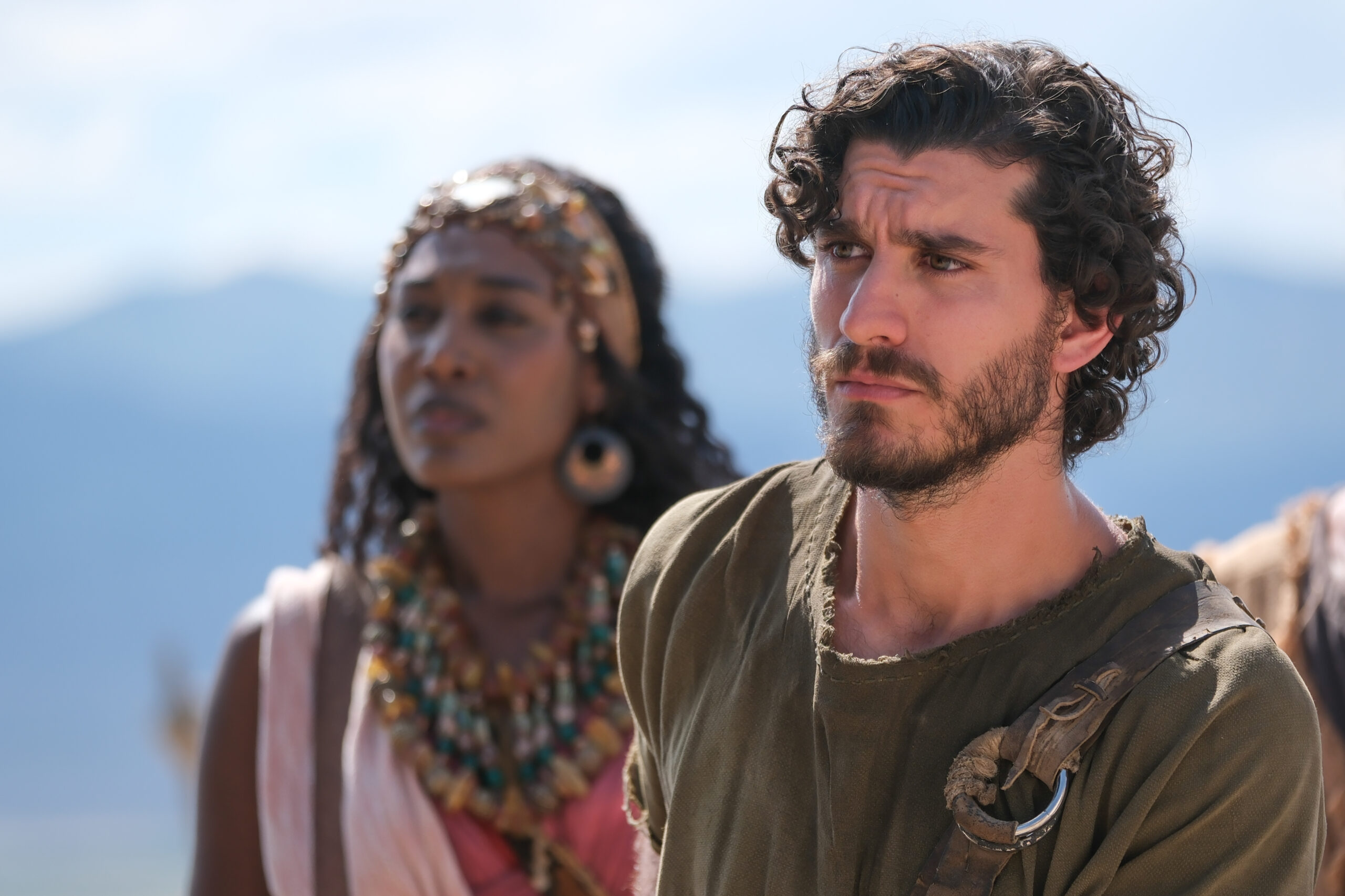
Greek-Australian actor George H. Xanthis chatted with #Powerjournalist Markos Papadatos about Season 6 of “The Chosen” and his Greek heritage.
For George H. Xanthis, portraying John the Apostle in the internationally acclaimed series “The Chosen” has been much more than an acting opportunity. It has been a transformative journey of discovery, faith, cultural connection, and personal growth… one that has brought him closer to his Greek roots while allowing him to explore one of the most fascinating figures in biblical history.
Heritage
Born in Australia to a family with deep Greek roots, Xanthis has embraced the opportunity to bring John to life on screen, discovering along the way the apostle’s connections to Greece, the Orthodox Christian tradition, and the island of Patmos (where the Apocalypse was written).
Through the years, the actor has also developed a deeper appreciation for the power of storytelling and its ability to inspire, comfort, and guide audiences.
As “The Chosen” approaches the conclusion of its remarkable journey in its sixth and final season, Xanthis looks back on an experience he describes as the job of a lifetime.
“It was good. Honestly, it was the job of a lifetime, with all its twists and turns,” he reflected. “We never imagined it would become what it ultimately did. It’s sad that it’s coming to an end, but it’s also right. We’ve told the story we needed to tell, and that’s a beautiful thing.”
Portraying John the Apostle
Playing “John the Apostle” proved particularly meaningful as Xanthis gradually discovered more about the historical and spiritual dimensions of his character.
“It was incredible, especially as I learned more about the character,” he said. “I discovered how connected John is to Greece, both historically and through Orthodoxy. That was wonderful to learn along the way.”
One of the most fascinating aspects of that discovery involved John’s association with the Book of Revelation, known in Greek as “Apokalypsis,” and the island of Patmos, where the apostle is traditionally believed to have received his revelation.
For Xanthis, these connections created an especially meaningful intersection between his professional responsibilities and his Greek heritage.
When he first began researching John, the actor sought guidance from a Greek Orthodox priest to better understand the apostle’s biblical background.
“I remember asking a Greek Orthodox priest about him,” he recalled. “I got the biblical overview of where John ended up: he was Jesus’ closest disciple and the one who remained with Him at the Cross.”
However, the screenplay introduced him to another fascinating dimension of John’s personality. “One thing the screenplay taught me was that John was initially known as a ‘Son of Thunder,'” Xanthis explained.
That discovery helped him approach the character with greater complexity, particularly when it came to John’s youthful personality and occasional arrogance.
“Whenever Dallas Jenkins, our director, creator, and one of the writers, would give me direction, he would often say things along the lines of, ‘Let’s make John a little more arrogant’ or ‘Let’s make him a little cheekier,'” he said.
The experience also allowed Xanthis to explore a different side of his own personality. “On a personal level, it also allowed me to express my comedic side a little more.”
Greek Orthodox faith
Beyond his work on the series, Xanthis has enjoyed opportunities to deepen his understanding of the Greek Orthodox Church. One particularly memorable experience was meeting Ecumenical Patriarch Bartholomew.
“Oh, my goodness! It was incredible,” he said. “I learned so much about him, His All-Holiness, and the Orthodox Church.”
Meeting Ecumenical Patriarch Bartholomew
The actor admitted that, like many members of the Greek diaspora, his connection to the Orthodox tradition had largely revolved around celebrating Greek Easter. Meeting the Ecumenical Patriarch, however, opened the door to a much broader understanding of the Church’s history and spiritual heritage.
Among his discoveries was the connection between Patriarch Bartholomew and St. Andrew, the First-Called Apostle, who is regarded as the founder of the Church of Constantinople.
“When he mentioned St. Andrew, I immediately thought, ‘We have a St. Andrew in our show!’ Then I realized it was the same St. Andrew, one of the twelve disciples,” Xanthis recalled.
He was also particularly impressed by the Ecumenical Patriarch’s environmental advocacy and his reputation as the “Green Patriarch.”
“I learned that Patriarch Bartholomew is known as the ‘Green Patriarch’ because of his commitment to the environment. He plants a tree wherever he goes to encourage the regeneration of life,” he said.
“I think that’s such an important message, especially today. Having someone like His All-Holiness, with so much experience and wisdom, teaching these lessons is truly special.”
The meeting was part of a broader visit that allowed Xanthis to connect with religious leaders and members of the Greek Orthodox community.
The delegation provided opportunities to meet not only the Ecumenical Patriarch but also archbishops, priests, and other representatives of the Church. “It was a really special experience,” he noted.
For Xanthis, these encounters were also closely connected to his own family history.
Although born in Australia, the actor proudly traces his ancestry to different parts of Greece. His maternal grandparents came from the Corinth region, with family roots in the villages of Gouda and Bassi. On his father’s side, his grandmother Maroula came from Akrata, in the Peloponnese, while his paternal grandfather was from the island of Kastellorizo.
“My father’s grandmother, Maroula, comes from Akrata,” he explained.
Xanthis recalled noticing something interesting during his travels to Kastellorizo: the ferry route splits, with one direction heading toward Patmos and the other toward Kastellorizo.
Last year, he decided to take the route to Patmos with his family, exploring locations associated with John and conducting research for the show’s final season.
“It was wonderful to see how my Greek heritage also helped me research different aspects of my character,” he said.
It was a rare opportunity to bring together his personal background, his family’s history, and his professional portrayal of one of Christianity’s most significant apostles.
While Xanthis was happy to discuss his experiences behind the scenes, he remained careful not to reveal too much about the upcoming sixth season of “The Chosen.” Xanthis did, however, offer an intriguing glimpse into John’s evolving journey.
As the story progresses, John begins to separate himself from the other disciples, spending more time with Jesus’ female followers and helping ensure their safety as they accompany Him.
“John also wants to make sure everything is okay with his Rabbi,” Xanthis explained.
This new responsibility brings its own challenges, particularly when Roman soldiers are involved. Although there are not many Greek actors on the production, Xanthis enjoys having another connection to his heritage through Nick Shakour, who portrays his on-screen father, Zebedee.
“Nick Shakour, who plays my father, Zebedee, also has Greek heritage,” he said. “So it’s nice that my on-screen father is Greek, too. We have to keep the Greeks together!”
Lessons learned from the screenplay
As for the message he hopes audiences will take away from Season 6, Xanthis believes this chapter of “The Chosen” carries particular significance. “I think this is the most important season yet,” he declared.
The central theme he hopes viewers will embrace is surrender… a concept that has resonated deeply with him both as an actor and as someone watching the story unfold.
“The one message I would like audiences to take away is the importance of surrender. It’s such a powerful theme throughout the season, and it’s something I’ve taken from the show both as an audience member and as an actor playing John.”
For Xanthis, John’s journey is characterized by an ongoing process of surrender. However, the ultimate example comes from Jesus Himself, who accepts His destiny despite the suffering and heartbreak that lie ahead.
“John is constantly surrendering,” he observed. “The ultimate example of surrender is Jesus Himself. He doesn’t fight His destiny, even though the path ahead is incredibly dangerous and heartbreaking.”
He believes this message has a profound relevance beyond the biblical setting of the series. “Ultimately, His message is one of salvation and hope.”
Xanthis continued, “I think His surrender teaches us that even when things aren’t going well in our own lives, sometimes we need to let go, trust, and have faith.”
Reflecting on the crucifixion and resurrection, he emphasized the importance of remembering that even the most devastating experiences do not have to represent the end of the story.
“One of the worst things imaginable happened to Jesus on the Cross. Yet He overcame death. That reminds us that we, too, can overcome the challenges we face in our lives.”
It is a lesson that extends naturally into Xanthis’ own philosophy about his profession and his place in the world.
Favorite motto to live by
When asked what success means to him, the actor offered a simple yet powerful personal mantra. “My personal mantra in life is: ‘Live to serve, always.'” He hopes that philosophy is reflected in the projects he chooses and the stories he helps bring to audiences.
“As an actor, you always want to be a storyteller. You want to tell stories that make people feel something and, hopefully, offer them guidance in their lives.”
Through “The Chosen,” Xanthis has witnessed firsthand how television and the arts can reach people in meaningful ways. “I never anticipated just how important storytelling, the arts, and filmmaking could be. But seeing the way audiences have responded to “The Chosen” has made me realize how much television, art, and storytelling can influence and guide people,” he said.
“I hope I can serve others in that way through my work.”
Success
For him, success is not simply about professional recognition or the next acting opportunity. It is about enjoying the journey, continuing to tell meaningful stories, and knowing that his work has touched someone.
“Success means enjoying what I do, continuing to tell meaningful stories, and knowing that people feel something through the work I create.”
New stage of his life: fatherhood
Away from the cameras, Xanthis is embracing an entirely new and rewarding chapter of his life: fatherhood.
He recently became a father to his son, Leonidas, who is approaching his second birthday. It is a life-changing experience that has given him a new perspective on responsibility, love, and sacrifice.
Asked to give this chapter of his life a title, his answer was immediate and particularly fitting. “Sacrifice,” he revealed.
With a smile, he acknowledged the interesting parallel between his personal journey and the central theme of the upcoming season of “The Chosen.”
It is perhaps the perfect way to describe where George H. Xanthis finds himself today: an actor reflecting on a remarkable professional journey, a Greek Australian rediscovering his cultural and spiritual heritage, and a father learning the meaning of unconditional love.
Closing thoughts on his character, and ‘The Chosen’
Through his portrayal of John the Apostle, he has discovered that storytelling can be an act of service, that faith can offer hope during difficult moments, and that sometimes the greatest strength comes from surrender.
As he moves into this next chapter, his guiding philosophy remains unchanged: “Live to serve, always.”
His favorite singer is Konstantinos Argiros, and he shared that he would love to someday work with him, if he were to ever go into acting professionally. “‘Kabanes’ by Konstantinos Argiros is my favorite song, and it’s my son’s favorite song,” Xanthis concluded.
To learn more about actor George H. Xanthis, follow him on Instagram.