

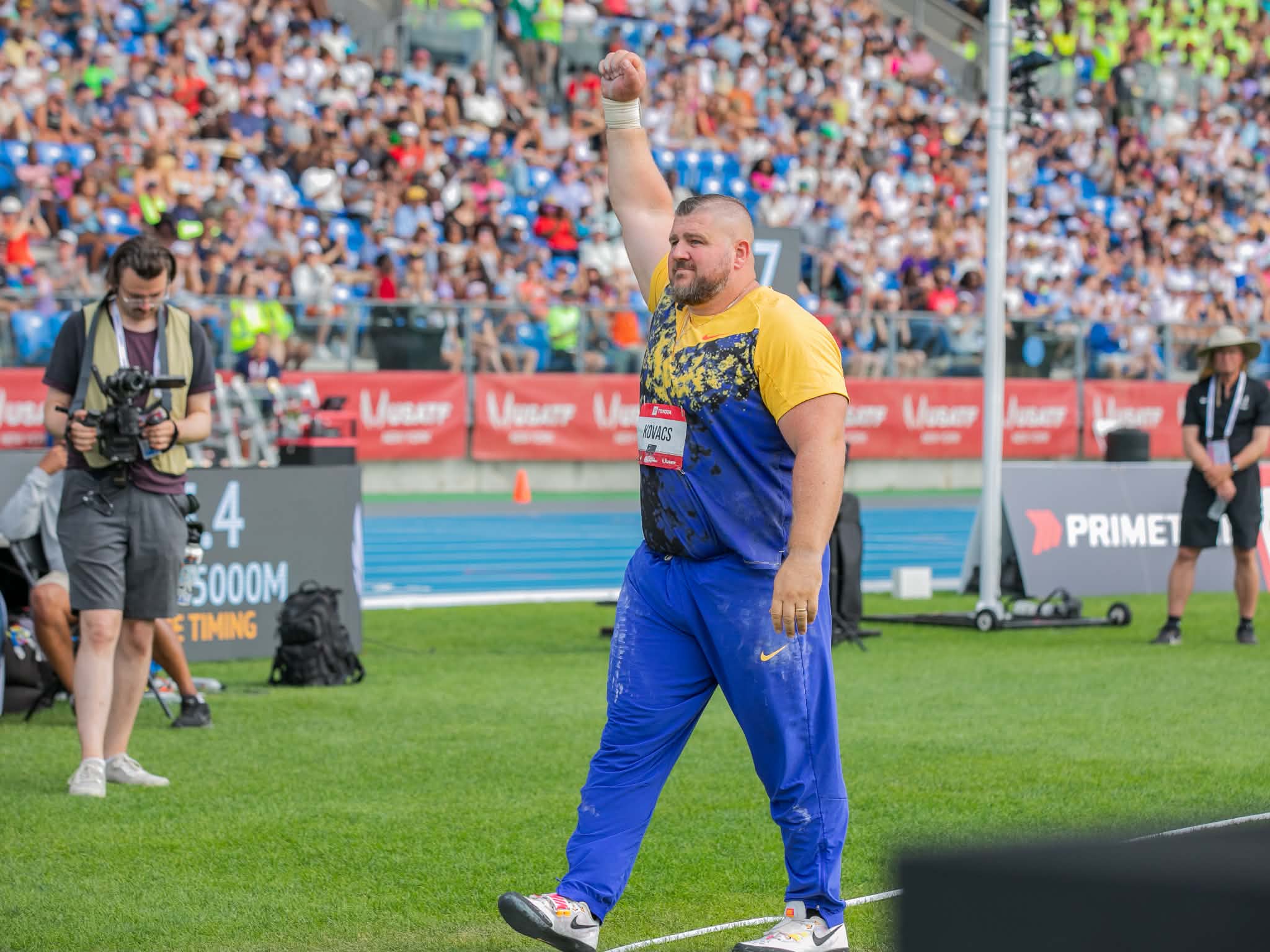
Three-time Olympic silver medalist Joe Kovacs chatted with #Powerjournalist Markos Papadatos at the 2026 USA Track and Field Championships, which were held at Randall’s Island Park in New York.
How does it feel to compete in New York?
I love coming to New York. Everybody probably knows I hate throwing indoors, but I love competing here because of the atmosphere. There’s just something special about New York. I’m a member of the New York Athletic Club, so it feels like a home away from home. Having the national championships here makes it even more meaningful.
Of course, I always enjoy competing in Oregon too, but New York is unique. I try to compete at every meet I can, and being here is still one of my favorite places to throw.
What’s the key to your longevity? You’ve been competing at the highest level for so long.
That has really been the challenge this season. I’m 37 now—not 27—so I have to be smarter about how I approach the year.
I started the season well with 23.58 meters in Rabat, but looking back, I don’t know if it was the best thing for my body to go from Rome to Los Angeles to Fontainebleau and then come here. That’s just a lot of travel and competition.
I always want to show up at every meet I can and give my best, but I think one of the biggest lessons this season has been learning to be more strategic and thoughtful with my schedule. Even when a season isn’t perfect, there’s always something to learn.
What advice would you give young and aspiring shot putters?
Learn to enjoy the boring stuff. Everybody wants to talk about personal bests, but nobody wants to talk about what to do on the bad days. One of the biggest goals should be raising your minimum level of performance.
Everybody chases PRs. Instead, chase your bad day. If you can make your bad days better, the PRs will come naturally.
What would you like to say to your fans?
Just thank you for all the support over the years—the highs and the lows.The crowd here in New York was incredible today. Sometimes that’s tough because there are days when you know you don’t quite have your best performance in your back pocket, and you feel like you’re letting people down because you want to put on a great show.
But I’m incredibly thankful, especially at this stage of my career. The people who’ve supported me have been there through so many ups and downs. It’s fun celebrating the big moments together, but it’s also meaningful when people stick with you after a tough day and say, “We’ll see you at the next meet.” That’s what it’s all about, and I’m very grateful for the fans.
What does success mean to you now?
That is a great question because my definition of success has changed. Earlier in my career, success meant medals and championships. Now it’s more about perspective.
When I think about what I want to teach my kids, success isn’t just standing on top of the podium. It’s falling down, getting back up, learning from failure, and continuing to move forward.
Obviously, champions win medals, but the reality is you have far more bad days than good ones. I recently watched Breaking Point on Netflix, and I loved it because tennis is such an individual sport. There are 128 players in a tournament, and only one leaves as the champion. But there are a lot of competitors who put everything on the line, and that’s what being a champion is really about.
For however many years I have left competing, success means being willing to go all in. Earlier in my career, I was sometimes cautious—making sure I could support my family and protecting myself. Now I want to fully commit, chase championships, chase big throws, and pursue goals we’ve always talked about but maybe never fully embraced.
Those are the lessons I want my kids to learn. If you’d asked me what success meant when I was 27, I would’ve said winning the 2015 World Championship. Today, I’d tell you it’s about having the mindset to handle adversity and keep moving forward.
One of the biggest lessons I ever learned came from Reese Hoffa. In 2014, when I won my first U.S. title, Reese had an off day. I expected him to be devastated, but instead he simply said, “I’ll go win the Diamond League Final and earn my automatic spot for Worlds” and that’s exactly what he did.
That kind of maturity—that ability to stay calm, learn from a setback, and immediately focus on the next opportunity—is what a championship mindset looks like. Honestly, at this stage of my career, I think I’m learning even more from the way Reese carried himself than I ever did from watching how far he threw.
To learn more about Joe Kovacs, follow him on Instagram.