
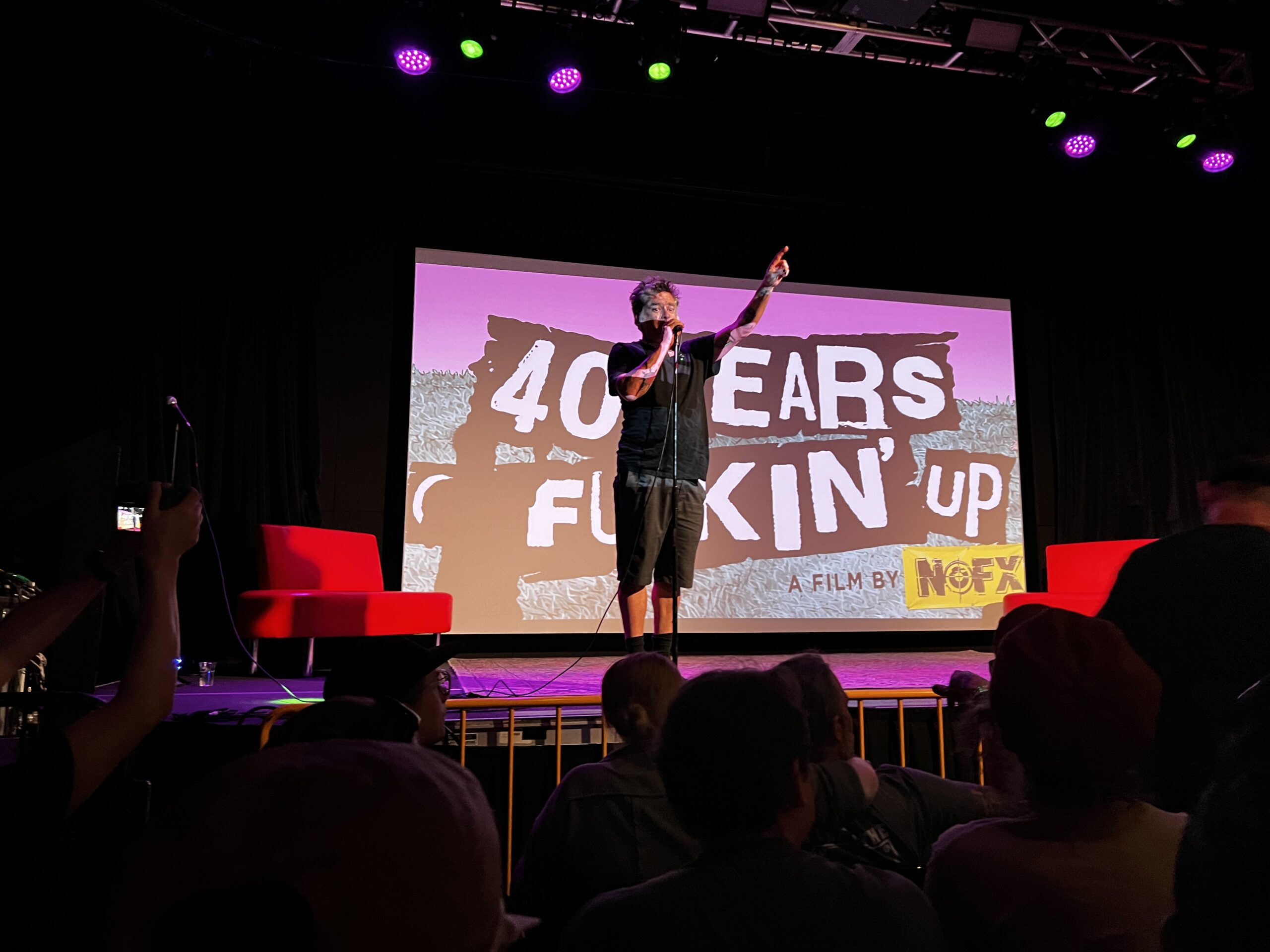
When Mike Burkett (“Fat Mike”) founded NOFX in 1983 as a three-piece punk rock band with no musical skill and a $225 studio budget, nobody could have predicted that four decades later the band would still be standing—scarred, mostly sober, and more honest about their failures than their successes. At this year’s SXSW 2026 in Austin, Texas, the world premiere of 40 Years of Fuckin’ Up finally told that story across five curated chapters: not as a triumphant rock narrative, but as a raw, unfiltered account of addiction, manipulation, brotherhood, and the stubborn refusal to sell out.
For those who never understood NOFX—who dismissed them as a novelty punk band or wondered why they never “made it” like Green Day or The Offspring—this documentary is a reckoning. For the faithful who followed them from tiny LA clubs to European festivals, it’s a mirror held up to 40 years of complicated, messy, beautiful punk rock life.
The documentary screening occurred on Sunday, March 15 and Monday, March 16. True Hollywood Talk attended the first screening of 40 Years of Fuckin’ Up on March 15.
The First DIY Band Who Knew They ‘Sucked’, But Played Anyway
Throughout the film, Burkett reveals that he didn’t grow up wanting to be a musician. He grew up wanting to escape.
We learn a lot about Fat Mike’s upbringing: a household marked by an active alcoholic father and a codependent mother. He revisits his teenage self: the Mike Burkett who found himself emotionally abused and verbally assaulted, searching for acceptance anywhere he could find it.
When he first heard the Sex Pistols and Circle Jerks at summer camp, something clicked. Punk rock wasn’t just music—it was a lifeline. Proof that you didn’t have to be good at something to do it. You just had to be authentic.
Spread across five distinct chapters, 40 Years of Fuckin’ Up does a hauntingly beautiful job of visually showcasing what genuine authenticity sounds, feels, and smells like.
The Birth of NOFX
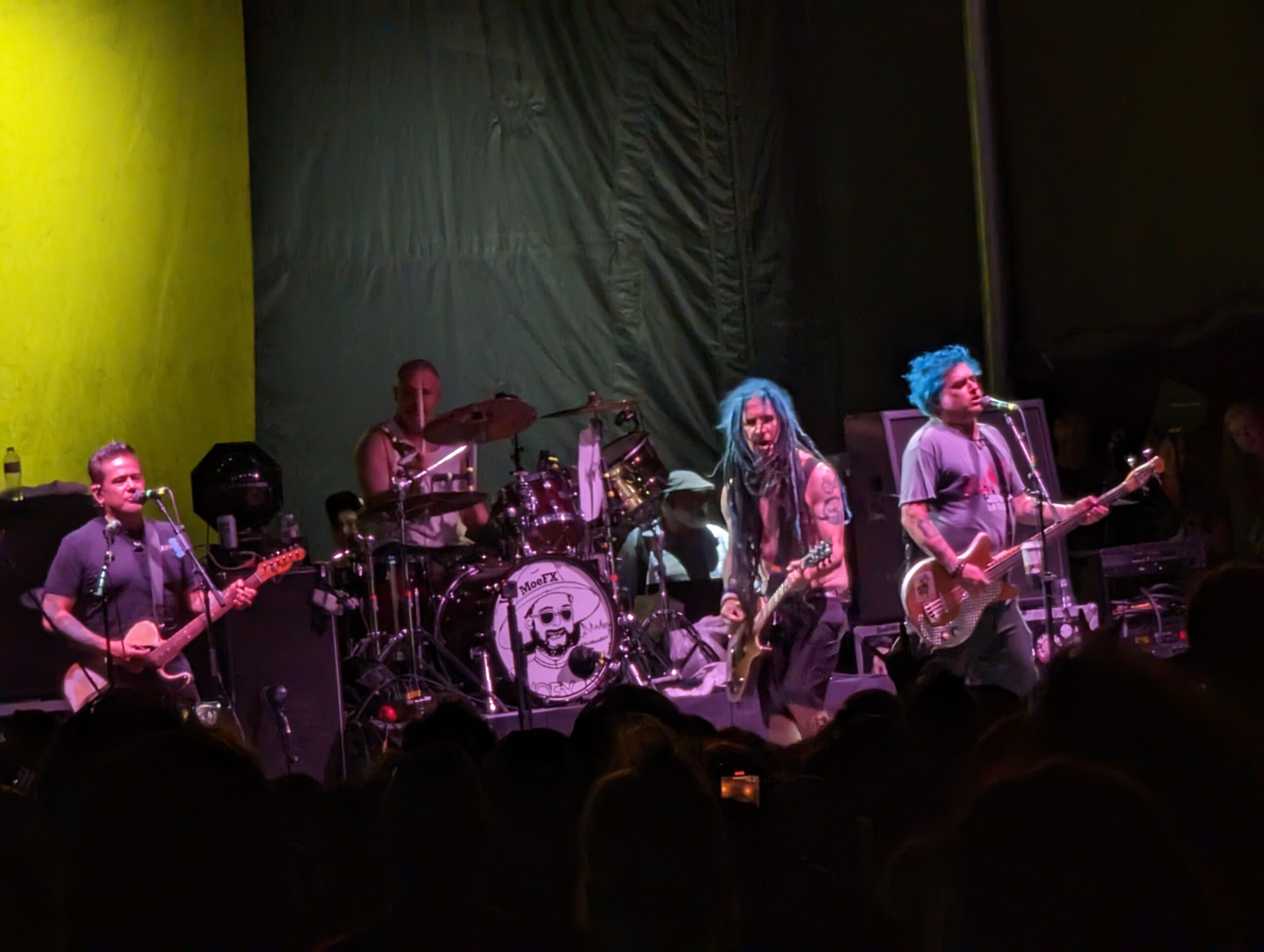
NOFX’s origin story began in 1983 with three kids who couldn’t play their instruments.
They borrowed a drum set that hadn’t been touched in years, a guitar that came as a Christmas gift, and a bass player willing to learn on the job. They found interim band members who jumped ship due to lack of patience, vision, or the ultimate fear of failure–until NOFX found their last permanent member and lead guitarist and trumpet player Aaron Abeyta (“El Hefe”) in 1991.
They toured before they released any music. They drove in a station wagon with a broken back window, duct-taped plastic flapping in the cold, because that’s what you did when you were broke and hungry and desperate to prove something.
The DIY ethos wasn’t a marketing strategy—it was survival. Early in the screening, the band recalls a club owner offering them $13 not to play. They proudly admit that payment was the most money they’d ever made at the time. They took it. And then they kept playing anyway, because that’s what mattered: the music, the community, the raw energy of kids who had nothing but each other and a reason to rage.
But alongside the camaraderie came the darkness.
By the late ’80s and early ’90s, heroin had infiltrated the band. Eric “Smelly” Sandin—a drummer with talent and demons—reveals his own story as a then full-blown addict, spending tours trying to score drugs and play 40-minute sets, his life collapsing in real time while the rest of the band watched helplessly. The devastating blow for Sandin came early: his likeness used as the cover image for a Rolling Stone article that exploited him as a trending mechanism to reintroduce the narrative of heroin’s return among punk musicians.
For the audience, heartbreaking was an understatement—and somehow it became the thing holding all of us in that room together. Tears, laughter, empathy, and understanding blanketed the space.
This was the contradiction that would define NOFX for decades: the most authentic, anti-establishment band in punk rock was also a band held together by addiction, denial, and the kind of love that makes you complicit in someone else’s destruction.
Morality for the Greater Good?
NOFX’s reckoning with heroin in the early 1990s revealed that the band actually had something to lose. Facing the real possibility of losing their drummer entirely, Fat Mike made a devastating calculation: unless Smelly got clean, he was out.
It was an ultimatum wrapped in love. But it was also a manipulation—the kind Fat Mike would later justify as being “for the greater good,” even as he wrestled openly with the morality of choosing the band’s survival over a friend’s autonomy.
The intervention worked. When their drummer reemerged—shaved head, no dreads, sober for the first time in years—something shifted for the early iteration of NOFX.
And then the band took off. White Trash, Two Heebs and a Bean became their breakthrough. Punk in Drublic went gold. Suddenly, NOFX was everywhere—or at least, everywhere underground.
The Weight of 40 Years
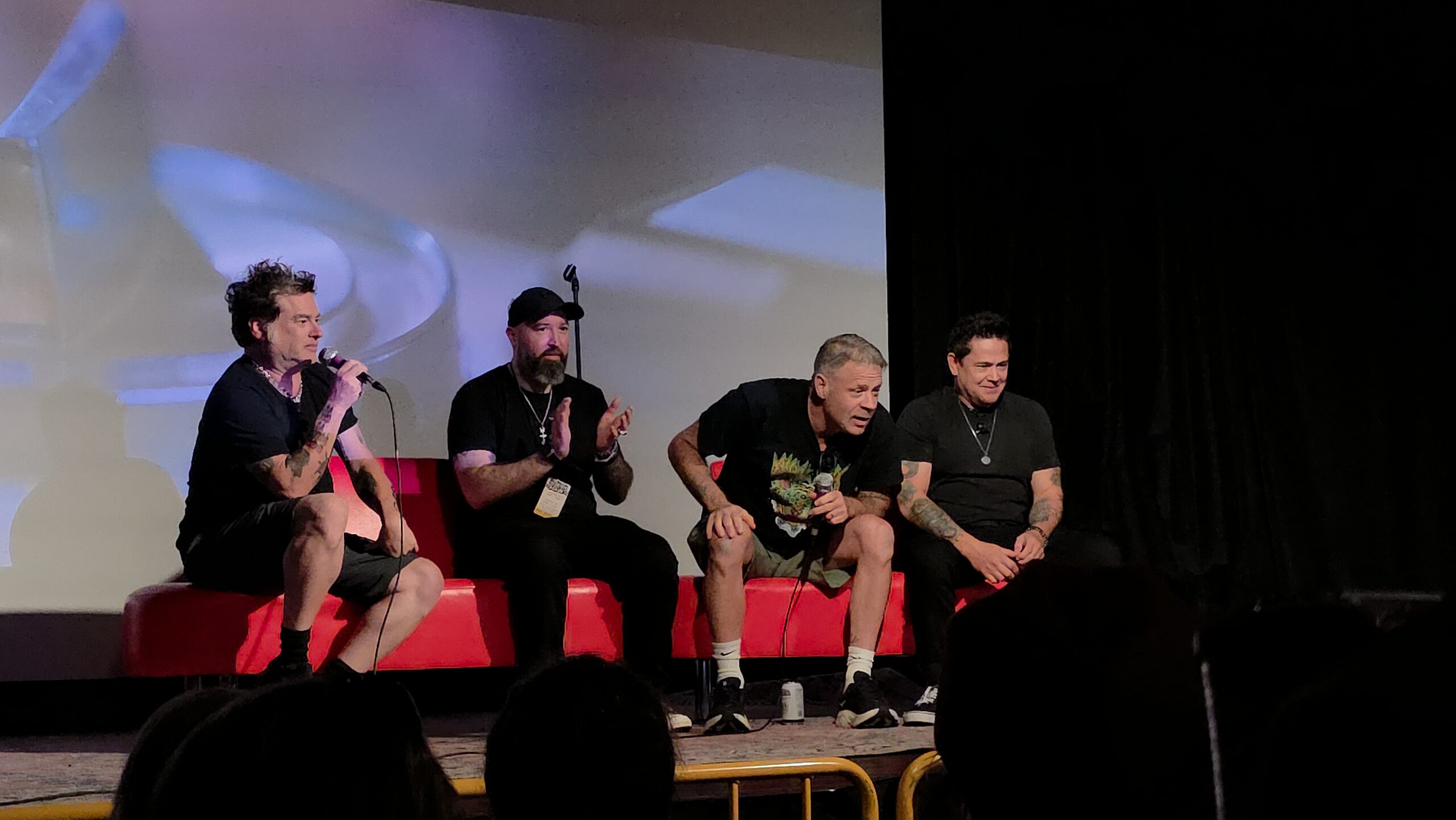
NOFX made a deliberate choice not to pursue mainstream success. They turned down MTV. They refused radio play. They stopped doing press interviews entirely for eight years, according to Burkett. It was a strategy born partly from principle—a genuine belief that mystery and cult status were worth more than commercial validation—and partly from fear. Fear that if they got too big, they’d lose the thing that made them special.
“The word of success is happiness,” Fat Mike admits later in the documentary. But happiness was getting harder to find—not just for the band, but for each of its members individually.
As the film moves into the early 2000s, we begin to see how the toxicity of NOFX’s internal dynamics had started seeping outward. But if you do the math over the course of 40 years (coming and going), you have: late nights, alcohol, cocaine and heroin, band monetization and profit sharing strategies–all while strategizing how to build something that would last, which is a heavy, heavy crown to wear.
From accusations of theft and betrayal to more interventions and desperate attempts at rekindling, the shadow of toxicity deepened over the years.
At one point, one member’s wife was banned from being on stage during performances because another member was so angry at her—a detail so petty and so revealing that it exposed the rot beneath the surface. The brotherhood was fracturing under the weight of decades of substance abuse, resentment, and unspoken grievances.
The refrain of “unless you go to rehab, we will no longer play with you” was more than a threat. It was an act of tough love, but also an act of self-preservation. The band was choosing itself over the individual, again. And the defensive responses to those ultimatums were more than understandable, especially when open drug use by other members had long been framed as a “solution” rather than a problem.
A Bloody Horror Film and Three Cleaning Companies Later
Halfway through, the documentary pivots to one of the most disturbing and strangely cathartic sequences of the film. Admittedly, this weighed extremely on my mental processing until I felt I could properly put together this indie film review 10 days later.
Through painful laughter and unyielding tears, Fat Mike narrates the visuals of his own wake-up call—a dark, bloody medical emergency at the Palm Springs home of Avenged Sevenfold’s M. Shadows. Blood everywhere. Paramedics. A man convinced he was really dying this time, calling his daughter to say goodbye.
Internal hemorrhaging. The result of years of drug use, stress, and a body pushed past its limits. M. Shadows held the line with paramedics while his friend was in the kind of physical crisis that doesn’t leave a room untouched. Three cleaning companies later—some refusing the biohazard entirely—M. Shadows paid the estimated $1,100 bill himself and drove Burkett to rehab.
What follows is quietly inspiring. Burkett reflects on his 10-month sobriety: attending every class, exercising daily, paddleboarding in the ocean, and writing new songs—including NOFX’s final original composition, written about gratitude.
The Closet Door Opens: Meet the Real Mike Burkett
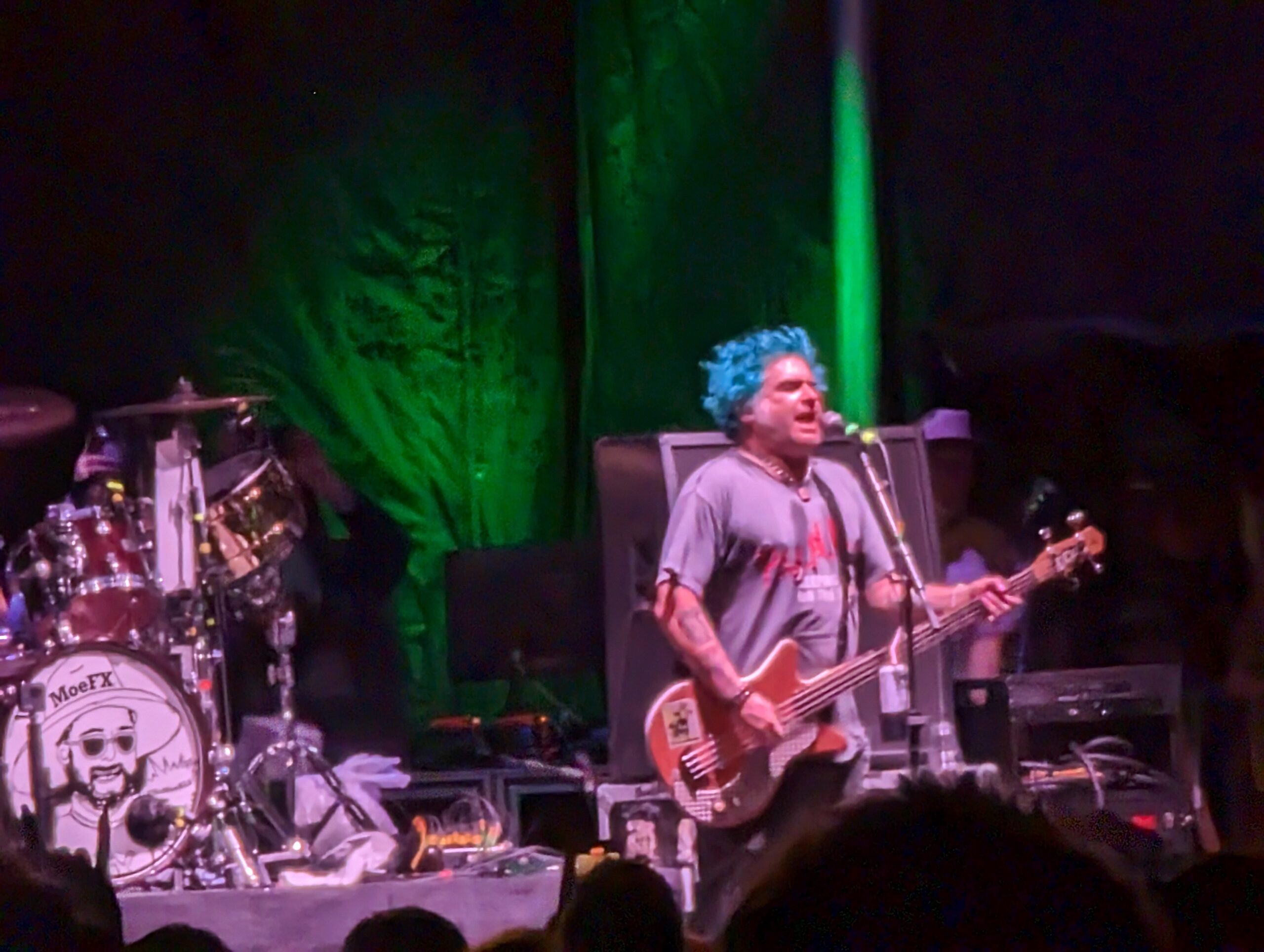
This is where the documentary becomes something else entirely.
Stepping outside the film review frame for a moment: as one of the producers of 40 Years of Fuckin’ Up, Fat Mike chose to do something that tested every fiber of his being. Something he had hidden for most of his life.
Burkett opens his closet to viewers. Not metaphorically. Literally. We’re shown closets full of latex, leather, women’s clothing, masks, shoes, toys—35 years of collected items representing a side of himself he’d been ashamed of for decades. He talks about being “mummified” in plastic at age 4, the sensory memory of latex against his skin—something that would haunt and define him. He talks about beginning to cross-dress as a teenager, the shame so consuming that he couldn’t enter an adult store without his girlfriend having to do it for him.
Burkett didn’t publicly cross-dress until he was 46 years old. Now, at 57, standing in front of a camera for this documentary, he says it out loud:
“I want to normalize it. Because it is normal.”
But this isn’t a side note in Fat Mike’s story, nor is it the film’s climax. It’s the core of it. The core of him. For 40 years, the founding member of NOFX: a man who preached authenticity and built a career on refusing to hide, had been hiding the most essential part of himself.
And in Austin, Texas at SXSW 2026, the audience finally had the privilege of meeting Mike Burkett, the human artist behind the persona of Fat Mike.
What makes it even more profound is what he says next — gently explaining what dressing up actually means for him:
“It’s being a man who is completely vulnerable and trusting someone.”
Mike Burkett (“Fat Mike”) / 40 Years of Fuckin’ Up (2026)
For someone who spent 40 years controlling everything: the band, the money, the narrative, the image—this act of surrender is the punkest thing he’s ever done. The most genuine expression of authenticity in a career built on it.
This isn’t a story about manipulation. Or drug use. Or even strategic entrepreneurship.
This is a masterpiece about NOFX, told by and through its members. And contained within it are the stories—pretty and ugly—that define each of them.
For Mike Burkett, the story of NOFX is ultimately the story of a kid who grew up in an abusive household, searching for acceptance, searching for a place where he could be himself. After 40 years, he’s finally found it—not in punk rock, not in NOFX, but in the terrifying, liberating act of showing the world who he really is.
“If you’re weird — if I’m not getting weird by opening my life up to other people, by filming it — I think it will help other people say, ‘Oh, he’s doing this. Because I kind of want to do that too.'”
Mike Burkett (“Fat Mike”) / 40 Years of Fuckin’ Up (2026)
If that isn’t the entire spirit and fabric of what punk is about, I don’t know what is.
Its languages? Duality and vulnerability.
Doing It Their Way as a Viable Business Model
Fat Mike had a vision for NOFX’s Final Tour, and it was pure NOFX: no corporate venues, no major labels, no compromises.
He called Cameron Collins and pitched a plan: parking lots instead of clubs, campgrounds instead of arenas, complete control over bar sales and merchandise. He wanted the lion’s share of the money to go to the band—not to Live Nation, not to AEG, not to any corporate middlemen.
He wanted to prove that after 40 years, NOFX could still do it their way.
Nobody believed him. When he told his bandmates they’d make eight to ten times what a regular tour generated, skepticism was the response. But Fat Mike had audited everything—the first time, by his account, anyone had ever audited a tour. He was going to prove that the DIY ethos wasn’t just romantic nostalgia. It was a viable business model.
The band couldn’t book shows in big cities. No Chicago. No New York.
Instead: Topeka, Kansas. Carbondale, Illinois. Champaign, Illinois. Small towns where they could draw their crowd and own the entire experience. Luckily, Austin, Texas was one of those cities.

Fat Mike even bought satellite numbers for $10 and called promoters from pay phones. It was 1985 tactics in 2024. And it worked.
Cut Scene, Cue the Lights
By the end of the Final Tour in late 2024, the numbers told the whole story. Adult Smelly reads off their final ledger in the documentary’s closing movement, bringing the film’s earlier scenes of the teenage Smelly reading off their first set of numbers full circle:
- $856 spent on gas for 40 weeks.
- $7.3 million made on merchandise.
- $6 million made on bar sales.
- An average of $260,000 per show in profit.
After expenses, each band member walked away with roughly $1 million, as it was presented.
They had done it. They had proven that independence, authenticity, and refusing to sell out could be more profitable than any corporate deal. The irony was bittersweet: they had finally won the game by ending it.
But here’s what the documentary actually reveals:
NOFX proved that you could be a functioning addict and still create something meaningful. That you could manipulate your bandmates for the greater good and still call it love. That you could turn down MTV and still matter. That you could play the same song wrong for 40 years and still have people show up to hear it.
NOFX’s greatest achievement wasn’t their music, though it was good. It wasn’t their independence, though it was rare. It was their refusal to pretend to be anything other than what they were: a bunch of fucked-up guys from LA who loved punk rock and each other, even when that love was messy, complicated, and sometimes destructive.
One of their peers said it best: “There’s not another punk rock band that could bring everybody together the way NOFX does… they brought something to the table that doesn’t exist anymore.“
They proved that punk rock was never about perfection. It was about authenticity, even when that authenticity was ugly.
“The Ugly”
While NOFX’s guitarist Eric Melvin was in Austin during SXSW 2026, he was not in attendance for the documentary’s debut or the post-screening Q&A. I won’t detail the current situation here—that’s not the role of this platform—but for reference, both sides have spoken publicly.
In his March 14th social media post ahead of the screening, Melvin wrote: “I love being in NOFX. I love my bandmates. I am so proud of what we’ve built together over decades.”
Prior to SXSW 2026, Eric “Smelly” Sandin shared the band’s on-the-record statement regarding the situation from The Punk Rock Museum in Las Vegas. That clip is available to watch from a third-party YouTube upload.
For the Newcomers
I grew up in a household where record players, punk rock, and stories from my parents weren’t things I had access to–which has made my adult years all the more exciting. I was learning for the first time about legendary bands and the stories that shaped them into the vinyl and digital files we listen to today.
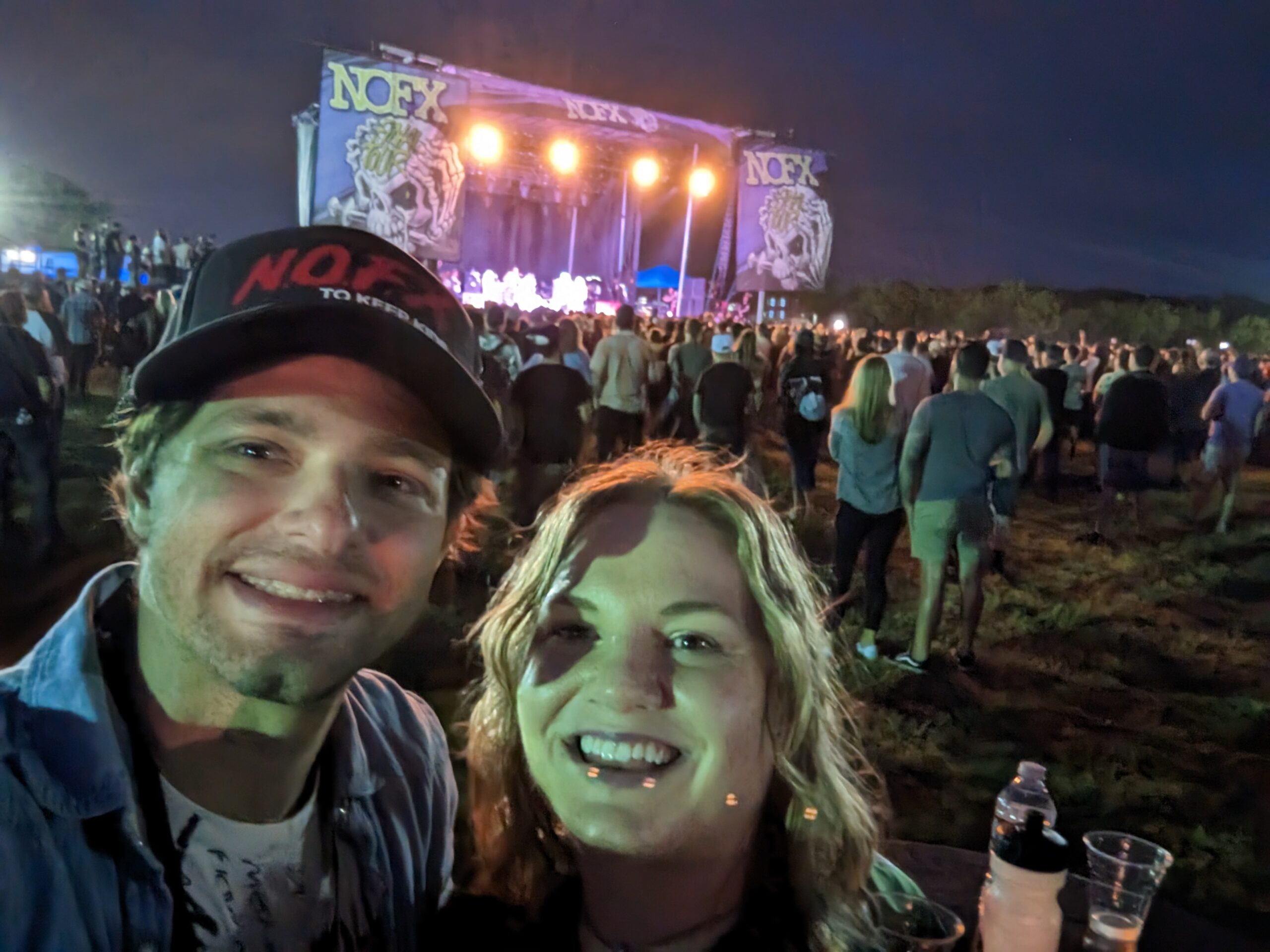
When I first met my (now) wife at SXSW 2020, just before lockdown, she introduced me to one of her all-time favorite bands: NOFX. It just so happened that my first-ever NOFX live performance also turned out to be one of the band’s last, as part of their Final Tour in Austin.
I’m eternally grateful to my wife, and to NOFX’s longtime friend and publicist Melanie Kaye, as well as The Punk Rock Museum.
If you’ve never understood NOFX, 40 Years of Fuckin’ Up will show you why they mattered. What I felt watching that debut screening next to my wife two weeks ago was more cathartic and freeing than I’ve felt in a long time.
Not because they were the best musicians. They weren’t.
Not because they were the biggest band. They weren’t.
But because they were real in a way most bands aren’t willing to be. They showed their addiction, their dysfunction, their failures, and their growth. They proved that you could fuck up for 40 years and still create something that moved people.
For the Loyalists
This documentary is a love letter and a reckoning. An acknowledgment that the band you loved was also a band held together by addiction, manipulation, and the kind of brotherhood that survives betrayal. It’s permission to love them anyway.
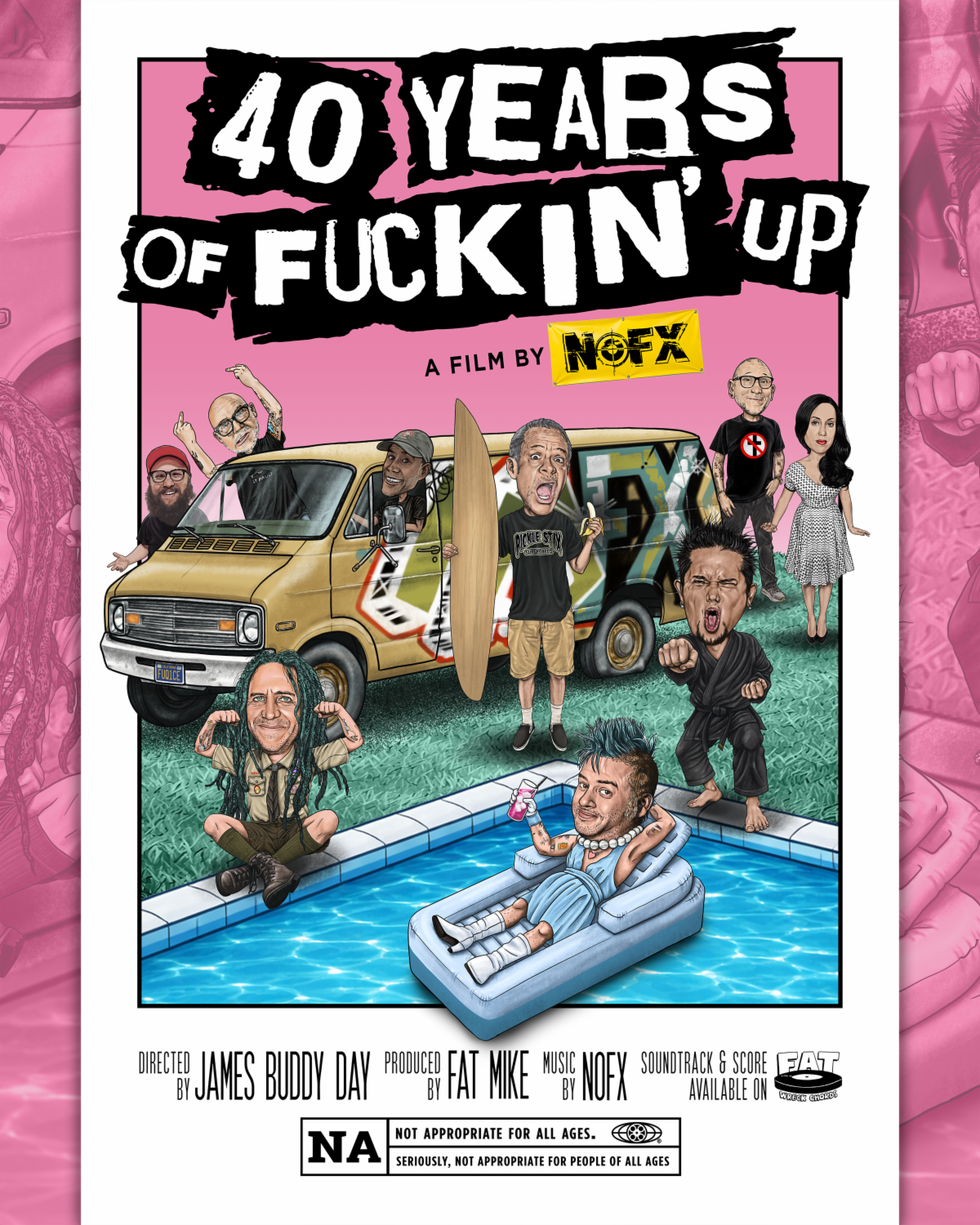
Directed by James Buddy Day, 40 Years of Fuckin’ Up premiered at SXSW 2026 in Austin, TX on March 14 and 15 at Brushy Street Commons. In attendance were Fat Mike, Smelly, El Hefe, and others closely associated with the band. Executive Producers include: Fat Mike, Aaron ‘El Hefe’ Abeyta, Erik Sandin, Eric Melvin, Gary Ousdahl, James Buddy Day, Cisco Adler and Jon Nadeau for Pyramid Productions.
A special thank-you to Melanie Kaye and NOFX for their generous hospitality over the last few years—at The Punk Rock Museum and in Austin, Texas as part of NOFX’s Final Tour and the debut screening of 40 Years of Fuckin’ Up.