
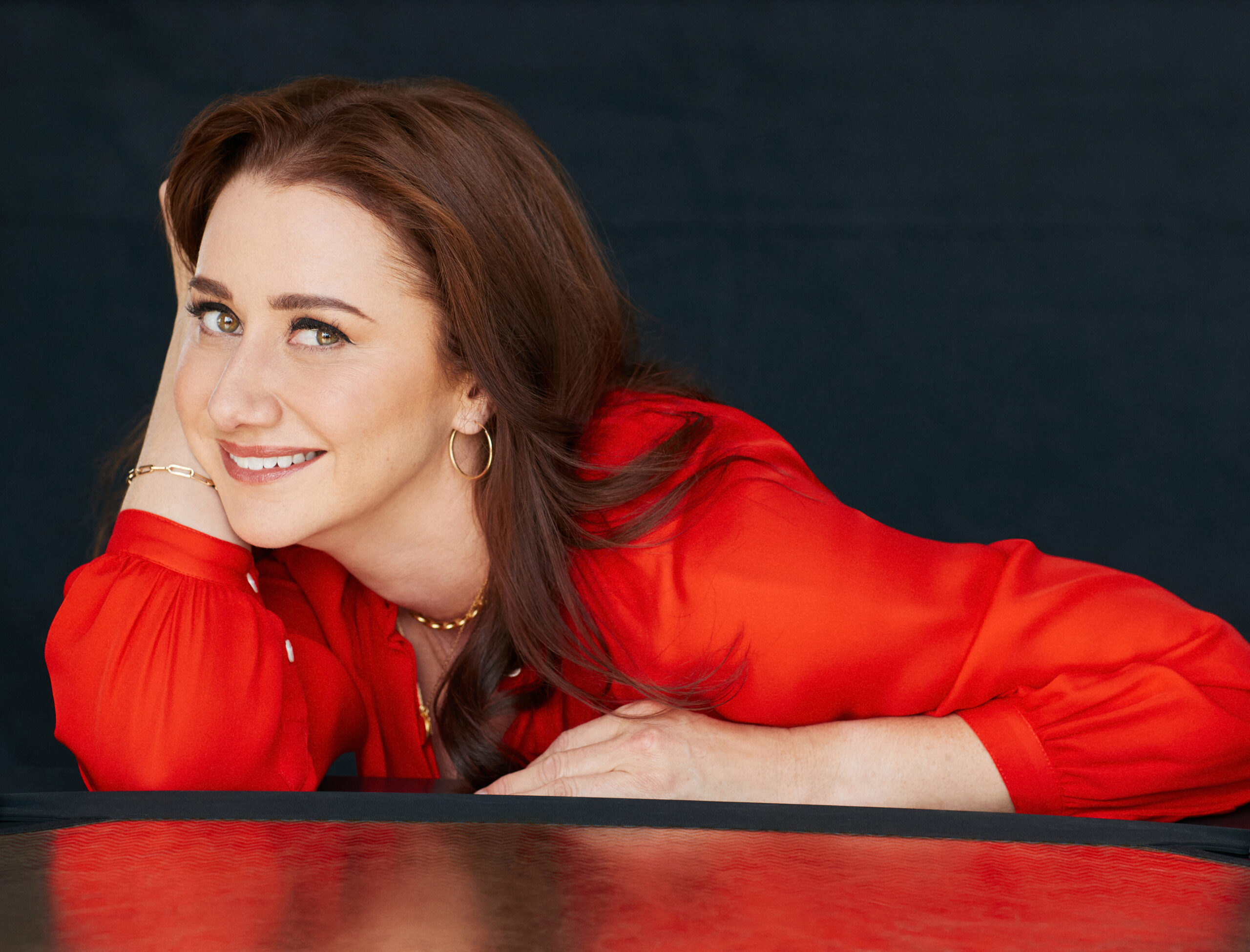
Julia Wackenheim chatted with #Powerjournalist Markos Papadatos about her new movie “Ethel & Ernie.”
Ethel & Ernie has already begun making its way through the festival circuit. What inspired the story, and what has it been like wearing so many hats as the writer, director, producer, and star of the project?
Since 2012, I’ve been advocating for domestic workers’ rights, long-term healthcare, and end-of-life care – locally, statewide, and nationally. That work put me in the middle of real relationships between those needing care and their caregivers, and I kept witnessing this specific mix of: complexity, tenderness, and comedy, often in the same five minutes. I hadn’t seen that particular dynamic on television – what it’s like to work inside someone’s home, to be both employer and something like family, the messiness of those boundaries and the real affection that grows out of it. Using my background in comedy, I thought this would make for a great sitcom.
Wearing all the filmmaker hats was a dream challenge. I wrote something alone, then showed up on set and directed the version of myself that wrote it, and then at some point I had to stop directing and remember, oh right, I’m also in this scene. Improv is the thing that made all of it possible. I came up through iO West and UCB, and the whole foundation of improv is that you don’t fight what’s happening, you build on it. I tend to lean on that principle when making projects.
If a scene wants to go somewhere I didn’t write, I say yes to that as a director. If we suddenly have to pivot to a different location, I say yes to that as a producer and figure out the next move. Improv helped me learn to trust my first instinct instead of overthinking everything, which is necessary when you’re under a time crunch like filming. I am very fortunate that I was given the opportunity to make “Ethel & Ernie,” and I really loved being able to create with so many different hats. It was incredibly fulfilling.
With Ethel & Ernie heading to additional festivals this summer, what are you hoping audiences connect with most when they experience the series?
I hope audiences see themselves in both Ethel and Ernie, the universal push and pull between two people who didn’t choose each other but ended up really needing each other. Anyone who’s cared for an aging parent, child, or anyone who’s given care, knows that specific mix of love and frustration, and dark comedy that comes with it. If people leave the screening thinking differently about the person who cares for their own grandmother, or just laughing at something that felt true, that’s the win for me.
And I hope people walk away actually seeing caregivers — not as background characters who exist to serve someone else’s story, but as full people with their own humor, exhaustion, dignity, and dreams. So much of the work domestic workers and in-home caregivers do is invisible, and I wanted to put that relationship front and center and let it be funny and messy and real.
You’ve performed in more than 1,000 live comedy shows and trained at legendary institutions like iOWest and UCB. How has your comedy background influenced the way you approach storytelling on screen?
Improv taught me to listen before I react, and that’s changed everything about how I write and direct. On stage, you can’t plan your way out of a scene; you have to stay present and build off what’s actually being offered to you. Someone says, “Chocolate covered tube socks?” And ya gotta say “Yes. Chocolate covered tube socks.”I bring that same instinct to writing dialogue: I want characters responding to each other in the moment, not just delivering lines that sound clever on the page.
Doing over a thousand live shows also beats a certain fearlessness into you. I learned not to be afraid of looking ridiculous, because at some point we all do. And I really, really have. I’ve wiped out on stage, performed with more people on stage than in the audience, and it was all great. It built the resilience required to self-fund and produce my own work.
And stand-up specifically taught me that I am not a stand-up, and that’s okay… right?
Throughout your career you’ve worked alongside comedy icons including Julia Louis-Dreyfus, Jason Sudeikis, and Mo Collins. What are some of the most valuable lessons you’ve learned from collaborating with performers at that level?
Throughout my career, I’ve been lucky to work alongside some genuinely iconic comedic performers, and each one taught me something different.
Watching Julia Louis-Dreyfus work is something I’ll never forget. She showed up to set for a “Jimmy Kimmel Live!” sketch and learned four pages of dialogue in about ten minutes — it was pure magic to witness. I performed alongside her in that sketch, and at one point she dropped a plate loudly on the counter right in front of me and another actor, breaking it as part of the bit — no fuss, no hesitation, just total command of the material and the moment. It taught me a lot about preparation versus presence — that at a certain level, the work isn’t just memorization, it’s an ability to absorb and inhabit something so fast that it looks effortless. It raised my own bar for what “being ready” actually means.
Mo Collins taught me something different, but just as valuable. I first worked with her onstage, and then again when I produced and starred in “F’d,” a web series where she brought that same energy to set. She’s one of the most generous performers I’ve ever shared a scene with — she comes in ready to play, fully in, no holding back, and that generosity is contagious. Working with her taught me that the best comedy happens when you’re not protecting yourself, when you’re willing to be all-in and trust that your scene partner is going to catch you. That’s something I try to bring into my own work now, whether I’m acting or directing other actors — creating a space where people feel safe enough to go all-in the way she did.
Between all of them, the throughline is the same: the best people at this level make the work look easy because they’ve done the internal work to be fully present. That’s the lesson I keep
coming back to. I’ve also learned a lot about longevity — comedy careers that last decades aren’t built on one big break, they’re built on consistently showing up prepared and easy to work with. It really is a marathon.
You portrayed Della on Fear the Walking Dead opposite Colman Domingo. How did stepping into that dramatic world differ from your work in comedy, and what did you take away from the experience?
Stepping on set for “Fear the Walking Dead” was one of the more surprising experiences of my career – because I expected it to be completely different from comedy. But it was just as funny and just as fun. Colman Domingo was hands down the funniest actor I’ve ever had the privilege to work with on set. He also always made everyone, including myself, feel included.
One night we filmed on a dock in Savannah, and the shot I was doing required me to run at top speed, hit a specific mark, and “kill” a zombie played by a stunt actor – all the while trying not to hurt the actor, slam into the camera, or tumble off the dock into the dark and scary water. It was physically intense and had no room for error. It taught me a lot about trust – trusting the other actor, my own body, and all the prep I had done for the shot.
It really shed a light on how similar drama and comedy are. The actors with the heaviest material are usually the ones who know how to make others laugh, which is needed to sustain the weight of drama day after day. It’s something I like to bring onto my own set: no matter how serious things are, you can always throw in some laughs. After all, we’re all basically playing with hot rod cars and Barbies, just on a different scale.
As a producer, you recently celebrated the Tribeca premiere of SELAH. What drew you to that project, and what excites you most about championing stories behind the scenes?
I was drawn to “Selah” because of Lara Everly, the director and writer, who was a finalist in Tribeca’s “Through Her Lens” program with this project. She’s a genius, and the work she’s doing is important. As a producer, championing stories behind the scenes means funding, cheerleading, and doing whatever it takes to help someone else’s vision get made — and I believed in “Selah” completely. Women-led projects are priceless to me. I believe that lifting each other up lifts ourselves up, and producing “Selah” was a chance to put that belief into practice.
“Selah” is about a determined teen who takes on a solo road trip from Texas to California to deliver a designer puppy for cash, and her responsibilities and emotions get pushed to the limit. But this isn’t your average short film. It’s a timely, cinematic exploration of agency and what it means to be a teen girl in America right now, using dark comedy to sneak past people’s defenses. There’s more to it — secrets get revealed, and it touches on issues that feel incredibly current. I won’t go further than that here; I think the film deserves to be experienced rather than explained.
Premiering at Tribeca with a “Through Her Lens” project was a full-circle moment. That’s the mission of the program — backing women filmmakers whose stories deserve a platform — and it’s exactly the kind of work I believe in, having spent so much of my own career working on underrepresented stories. “Selah” was in a block that had some of the best filmmaking I’ve seen — films from all over the world tackling heavy subjects with real craft and care. Being in the company of such talented filmmakers, for a film I believe in this much, was something I won’t forget.
In addition to Ethel & Ernie, you’ve written projects including Whoa Nellie! and co-written Super Drunk Girl. When you’re developing a new idea, what typically comes first for you – the characters, the premise, or something else entirely?
There’s no rhyme or reason to it half the time. Sometimes it’s a world, sometimes it’s a joke, sometimes it’s just a feeling I can’t shake until I write it down. Whatever the spark is: it always makes me laugh and want to see more.
Super Drunk Girl started as a joke. I was playing with the idea of drunkenness as a kind of inhibition-loss, and I thought — what if that loss of inhibition actually gave you superpowers? That would be so cool, and so fun, and so inconvenient! Let’s see that story.
Whoa Nellie! started somewhere completely different — with a real experience. I loved horseback riding. During the pandemic, exercise was tricky with everything going on around COVID exposure, so I started taking lessons together, and I fell in love with it. I wanted an excuse to be on a set working with horses. But the actual premise came out of thinking about who would live on a horse farm, and what their family dynamics would be.
Ethel & Ernie was a little different — the dynamic between Ethel and Ernie came first, before I knew exactly what the plot would be. I knew who they were to each other before I knew what would happen to them.
Once I get an idea, I work on outlines and beat sheets to build a structure. Whenever I sit down to write, I use a technique I’d read about via Dan Harmon – I attempt to write utter trash. How much can I offend myself with the writing? It takes the pressure off writing perfectly, and what I write is never actually trash…usually.
You’ve built a career across acting, writing, directing, and producing at a time when creators are increasingly forging their own paths. Looking ahead, what kinds of stories or creative challenges are you most eager to tackle next?
It’s an exciting time to be an independent filmmaker. There’s more opportunity now on a smaller scale than there used to be — the resources to make things are more accessible than they’ve ever been, and that’s changed what’s possible for people building their own path instead of waiting for permission. A lot of my acting career felt like I was waiting to be allowed to perform or create. Now there are fewer gatekeepers.
Looking ahead, I’ve been gravitating toward rom-coms lately – and starting to think in that longer format. I also want to get back to performing live written material, which is where a lot of
my storytelling instincts started in the first place. And I want to keep finding projects that are looking for supporters to help get their stories made. I love being a part of something from the beginning, and seeing the magic that comes from women working together.
Across all of it, the throughline stays the same: I want to keep telling funny stories about women. That’s the thread that connects Ethel & Ernie, Whoa Nellie!, Super Drunk Girl, Selah, and whatever comes next — women who are messy and specific and real, told through comedy. That’s the work I keep coming back to, and it’s the work I want to keep doing.
To learn more about Julia Wackenheim, follow her on Instagram.